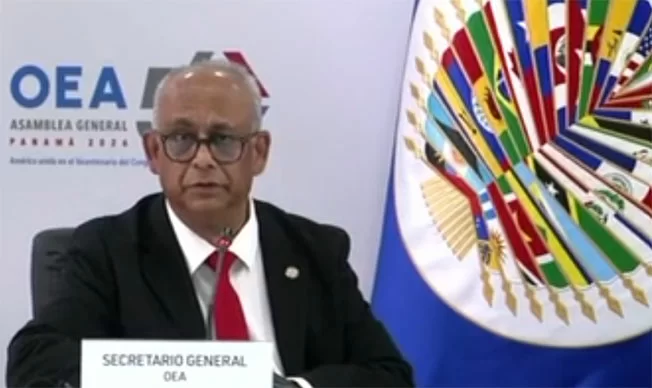
Against the backdrop of the 2026 Organization of American States (OAS) General Assembly, Secretary-General Albert Ramdin has laid out a transformative economic vision for the Americas, highlighting that the combined oil and gas sectors of Suriname and Guyana could position the region as the world’s second-largest oil production hub, if paired with strategic investment and inclusive regional collaboration.
Speaking at the High-Level Private Sector Dialogue held on the sidelines of the General Assembly in Panama, which brought together ministers, diplomats, and business leaders from nearly 40 countries across the hemisphere, Ramdin emphasized that the Western Hemisphere holds extraordinary untapped economic potential, driven by its abundant natural resources, strategic geographic positioning, unparalleled biodiversity, and dynamic entrepreneurial culture.
Current production data underscores this potential: Guyana already pumps roughly 900,000 barrels of oil per day, with projections pointing to output climbing to 1.8 million barrels daily by 2030. When combined with Suriname’s projected upcoming oil production increases, Ramdin noted that the combined Guiana Shield region is on track to become one of the most consequential oil-producing centers globally. However, he cautioned that natural resource wealth alone is not enough to deliver long-term, shared prosperity.
“Economic progress only emerges when governments and the private sector invest jointly in stability, good governance, and sustainable development,” Ramdin told attendees. He argued that durable growth requires strong public institutions, consistent rule of law, full transparency, and a predictable policy environment to retain and attract global investor confidence. Rather than focusing solely on exporting raw crude and gas, Ramdin urged regional leaders to leverage the energy boom to build local value chains, grow domestic industries, create high-quality local jobs, and fund long-term sustainable development projects across the region.
To advance this collaborative economic agenda, Ramdin used the dialogue to formally launch the OAS Private Sector Initiative of the Americas, a new cross-sector platform designed to bridge gaps between national governments, global financial institutions, and private enterprises to unlock investment, drive inclusive economic growth, and strengthen regional integration. Argentine business leader Bettina Bulgheroni has been appointed to chair the new initiative, where she will lead the development of concrete projects across key high-growth sectors including energy, critical minerals, artificial intelligence, digital transformation, trade, and investment.
Ramdin closed his remarks with a call for deeper collective action across North, Central, South America and the Caribbean. He noted that too much regional capital and economic activity currently flows outside the hemisphere, despite the Americas holding all the necessary assets – abundant natural resources, robust logistics connections, and skilled human talent – to play a far larger role in the global economy. He identified the global energy transition, digitalization, artificial intelligence innovation, and modernization of trade and logistics networks as the defining economic opportunities for the region over the coming decade.
“The future of the Americas depends on how we connect economic growth to democratic governance, security, and sustainable development,” Ramdin emphasized, framing the new initiative and the region’s energy boom as once-in-a-generation opportunities to deliver shared prosperity across the hemisphere.