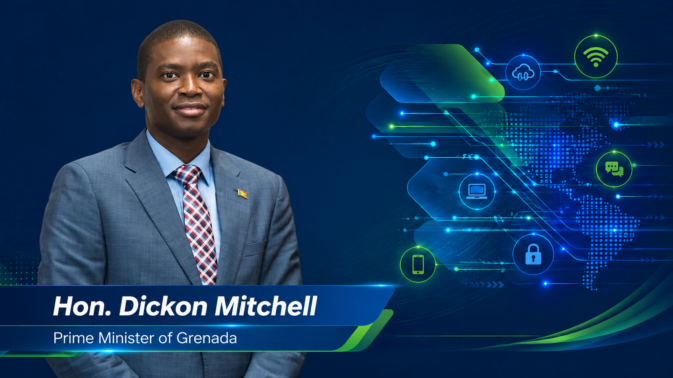
Against a backdrop of shifting global digital dynamics and rising economic uncertainty, Grenada Prime Minister Dickon Mitchell has issued a clarion call for accelerated, deeper regional collaboration to drive forward digital transformation across the Caribbean Community (CARICOM). As the Lead Head of Government responsible for Science and Technology within CARICOM’s Quasi Cabinet, Mitchell made his case at the opening session of a gathering of the bloc’s ICT ministers, an event convened around the core theme ‘Accelerating Digital Development to 2030’.
In his opening remarks, Mitchell emphasized that modern digital technologies have transitioned from optional innovations to foundational pillars of lasting economic resilience, robust national security, and inclusive sustainable development across the region. He pointed to the tangible progress CARICOM has already unlocked through collective action, including the advancement of the CARICOM Single ICT Space, formal adoption of the 2025–2030 Strategic Framework for Digital Resilience, and enhanced cross-regional coordination on critical cybersecurity initiatives.
“If CARICOM is to retain its global competitiveness and remain relevant in the 21st century, we must act collectively and strategically to guarantee our region is not sidelined on the margins of the fast-growing global digital economy,” Mitchell told assembled delegates. The prime minister stressed that small island states are particularly vulnerable to the ripple effects of global uncertainty, economic volatility, and shifting geopolitical tensions, making coordinated action non-negotiable as the world updates rules for key digital domains including artificial intelligence, digital trade, and data and internet governance. No individual CARICOM member state can successfully navigate the complex digital transition in isolation, Mitchell argued, noting that coordinated regional action is the only path to collective strength.
“It is time we move decisively from policy discussions to measurable implementation and tangible outcomes to build a unified CARICOM digital economy,” he added.
A key focus of Mitchell’s remarks centered on the transformative potential of artificial intelligence, a technology increasingly recognized as a defining force reshaping the global economic landscape. He noted that AI can streamline public service delivery, boost cross-sector productivity, and catalyze the creation of entirely new industries across the Caribbean. For CARICOM’s small developing economies, AI opens an unprecedented opportunity to leapfrog traditional, slower development pathways. Still, Mitchell cautioned that widespread adoption of the technology must be rooted in core principles of inclusion, public trust, and ethical governance to ensure benefits are shared broadly.
Mitchell also highlighted two under-prioritized priorities for the bloc: expanding investments in foundational digital infrastructure, strengthening cybersecurity systems, advancing digital skills training, and updating regulatory frameworks that can keep pace with rapid technological change, as well as equipping the region’s large youth population with the tools they need to participate and thrive in the growing digital economy. With 60% of CARICOM’s 16 million citizens under the age of 30, investing in youth digital inclusion is critical to unlocking the bloc’s long-term digital potential.
During the three-day meeting, ministers reviewed and formally approved new frameworks covering cross-regional digital cooperation, AI governance, cybersecurity standards, and digital skills development.
Established in 1973 via the signing of the Treaty of Chaguaramas, CARICOM revised its founding agreement in 2001 to enable the creation of a single market and single economy. Today, the bloc counts 15 full member states and six associate members, serving a combined population of roughly 16 million people. Its work is organized around four core pillars: economic integration, coordinated foreign policy, human and social development, and security cooperation. Widely regarded as one of the most successful integration projects in the developing world, CARICOM’s overarching mission is to build an integrated, inclusive, and resilient community driven by knowledge, innovation, excellence, and productivity, where every citizen has equal opportunity to pursue their potential amid guaranteed human rights and social justice, and shares in the bloc’s collective prosperity. The CARICOM Secretariat, the bloc’s central administrative body, is headquartered in Georgetown, Guyana.