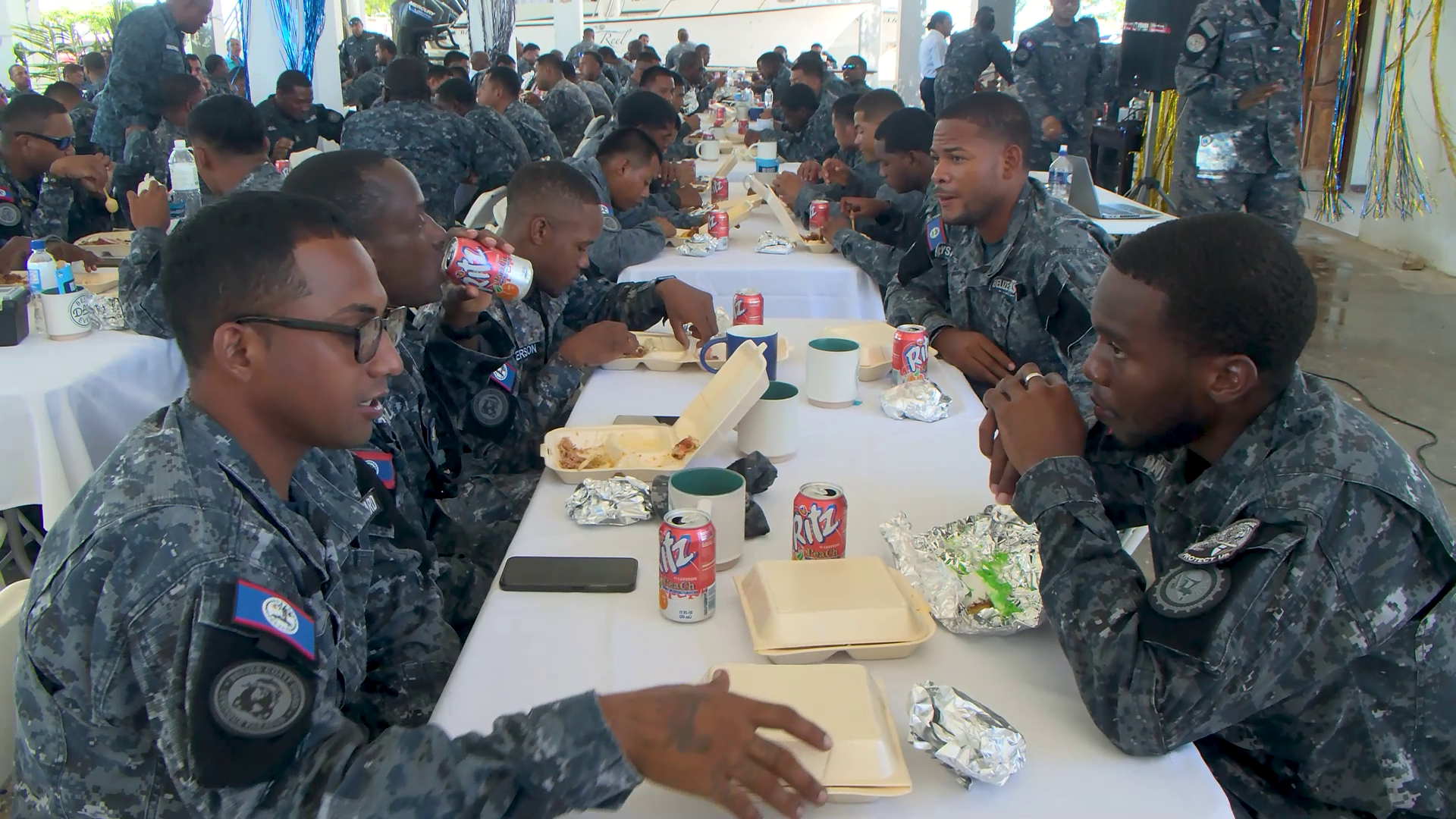
On Thursday, June 19, 2026, the Belize Coast Guard turned a routine Father’s Day commemoration into an unexpected focal point of public inquiry, after a celebratory luncheon for more than 150 serving fathers in the force prompted questions about the origin of the event’s food supplies.
What began as a tribute to recognize the contributions of uniformed fathers balancing national security duties and parenthood quickly shifted focus when observers noted the fresh rice, beans, and vegetables served at the meal. Reporters pressed Belize Coast Guard Commandant Rear Admiral Gregory Soberanis on whether the institution had sourced the produce from the high-profile Mira family, a line of questioning that sought clarity on procurement practices for the force’s annual multi-million-dollar supply contracts overseen by the Ministry of Defense.
Instead of addressing the supply chain question directly, Soberanis repeatedly emphasized that procurement and contracting fall outside the scope of his official responsibilities. As the service’s top leader, he framed his core mandate as upholding operational readiness, ensuring rigorous training for all personnel, and safeguarding Belize’s territorial waters. “Anything outside of that is beyond my purview. My focus is to ensure that the men and women here are trained, ready, and equipped to execute our mission and our mandate,” Soberanis told reporters, adding that he remained confident the Ministry of Defense prioritizes the well-being of all coast guard personnel.
While Soberanis has stepped back from direct involvement in tendering processes, he highlighted major strides the coast guard has made in recent months to modernize its operational capacity through new technology. Just weeks prior, at the end of May, the service partnered with the Southern Environmental Association and other local conservation groups to carry out a successful interdiction of three foreign nationals conducting illegal fishing near Gladden Spit, a key protected marine area off Belize’s coast.
A central driver of the operation’s success, Soberanis explained, has been the integration of unmanned aerial drone technology into regular coast guard patrols. The technology, he noted, acts as a critical force multiplier that extends the service’s monitoring reach across vast stretches of Belize’s extensive maritime domain. To build expertise in this emerging area, members of the Belize Coast Guard Drone Squadron completed advanced specialized training in Silicon Valley, equipping them to operate and maintain the new systems effectively.
Soberanis reaffirmed that the service remains committed to its core mission of “utrinque paratus” — prepared for any event — delivering on its mandate to protect Belize’s naval defense, maritime safety, and national security across the country’s waters. This report is a transcript of an evening television broadcast from the originating outlet.