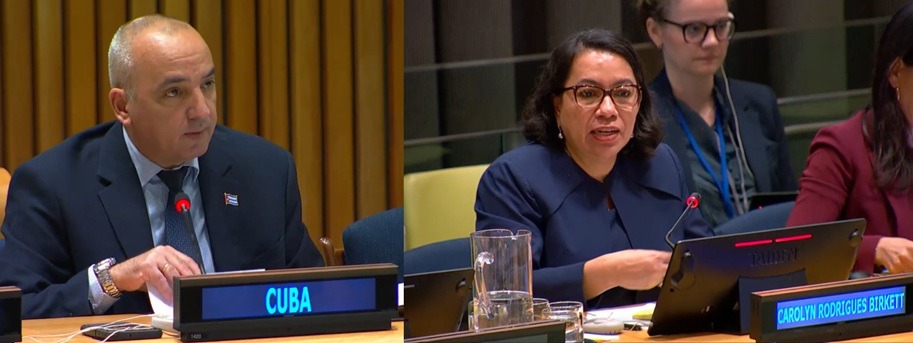
As the race to succeed outgoing United Nations Secretary-General António Guterres heats up, Guyanese nominee Carolyn Rodrigues-Birkett has laid out her core vision for global conflict mitigation, leaning on the UN’s longstanding “good offices” mechanism as a central tool to de-escalate rising international tensions.
Rodrigues-Birkett, who currently serves as Guyana’s Permanent Representative to the UN and recently completed a term on the UN Security Council, drew from her own nation’s decades-long territorial dispute with Venezuela to frame her approach to peacebuilding. “On conflict resolution, all the tools that are available to me as Secretary General, the good offices, I think that this is something we can use more. My own country benefited from the good offices process of the UN,” she told member states during an interactive question-and-answer session for candidates.
The UN’s good offices process supported negotiations between Guyana and Venezuela for half a century over a long-running territorial dispute stemming from the 1899 Arbitral land boundary award. After decades of mediated talks, Guyana ultimately brought the case to the UN’s International Court of Justice, where it remains pending with Guyanese officials holding out hope for a favorable ruling.
If elected to take the top UN post when Guterres’ term ends on December 31, 2026, Rodrigues-Birkett pledged to take a proactive approach to deploying the UN’s full suite of peacebuilding and conflict resolution tools to tackle rising global instability.
Beyond peace and security, the candidate linked sustainable development, educational investment, and human rights as interconnected pillars of a more stable global order. Drawing from her early political experience as Guyana’s Minister of Amerindian Affairs in 2001, she highlighted how targeted investment in education transformed underrepresented Indigenous communities. When she took office, she noted, there was just one Amerindian doctor serving Guyana’s Indigenous populations. After sustained public investment in accessible education, dozens of doctors and other professional leaders have emerged from these remote communities.
“I also see the investment in development and the investment in peace and security as also investment in human rights because when conflicts arise, many times, human rights is one of the things that suffer immediately,” she added.
However, during the interactive session, Rodrigues-Birkett chose not to directly respond to a pointed question from Cuba’s representative to the UN, which pressed her on two critical principles: curbing rising “war-like rhetoric” and upholding the global norm of non-use of force in international relations. The Cuban representative asked: “Given the growing escalation of conflicts and the proliferation of war-like rhetoric, what action would you take as Secretary General to promote a culture of peace and the peaceful settlement of disputes and respect for the principle of non-use of force?”
The question comes against a fraught geopolitical backdrop for Cuba: former U.S. President Donald Trump has recently openly floated the idea of forcing regime change in the communist-run Caribbean nation via military intervention. In recent months, the U.S. has expanded sanctions on top Cuban government officials and state-run entities, and sweeping U.S. trade restrictions have effectively crippled the Cuban economy by blocking most fuel imports, leaving the country reliant on sporadic fuel deliveries from Russia.
The non-response also comes amid worsening bilateral ties between Guyana and Cuba in recent months. Earlier this year, Guyanese President Irfaan Ali spoke on the sidelines of Trump’s “Shield of the Americas Summit”, where he stated that it was time for a “political transition” in Cuba. “There must be dialogue but those changes must lead to the improvement of the people of Cuba. It must lead to better conditions for the people of Cuba, must lead to a society in which the rule of law, in which democracy, in which freedom is celebrated,” Ali said at the event.