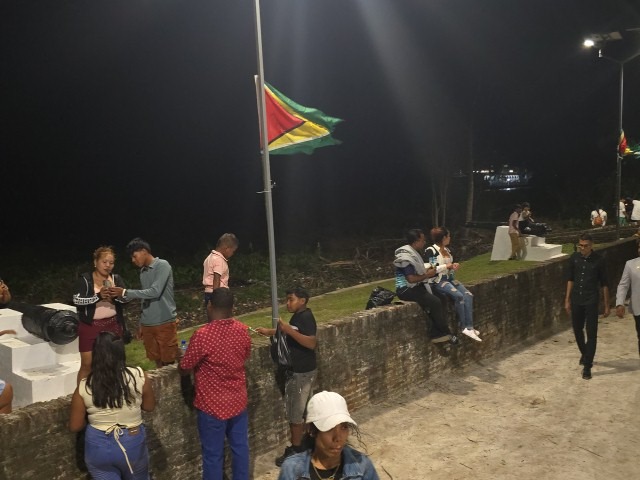
Last updated Friday, 19 June 2026, a leading urban and regional planning expert has sounded the alarm over severe, avoidable risks to Fort Zeelandia, a nearly 300-year-old brick heritage site on Guyana’s Fort Island in the Essequibo River, following unregulated activity tied to last month’s 60th independence anniversary flag-raising ceremony.
Dr. Allyson Stoll, a United States-trained city and regional planning specialist, outlined multiple harmful interventions that have already compromised the fragile 1749 structure in comments to Demerara Waves Online News. Pre-ceremony grading work stripped topsoil from areas adjacent to the fort’s historic structures, and bulldozers cleared a stand of mangroves – a critical natural habitat for native birds and marine species that also helped stabilize the fort’s surrounding soil.
During the evening ceremony, no officials were present to enforce heritage protection regulations set by Guyana’s National Trust. Witnesses observed members of the public climbing, sitting, walking and jumping across already weather-worn sections of the brick fort, while uniformed Disciplined Services personnel stood on the structure’s upper level.
Stoll emphasized that allowing foot traffic and weight-bearing activity on the fort’s historic brick revetments and earthen ramparts is never acceptable, given the site’s advanced age and fragile condition. “The entire section can collapse inward or outward, especially after the removal of vegetation that held the outer revetment in place,” she explained. “Bricks can become dislodged individually or in entire sections. The situation is already made worse by the fact that many loose bricks have previously been stolen by island residents to use as foundation material for private homes.”
Guyana’s National Trust has posted an official warning sign near the fort, stating that anyone who damages the protected site can face a fine of GY$130,000 and a court order to cover all costs of repairs. This mandate is formalized under the National Trust Act, which specifies that any person who disturbs, damages, or interferes with a national monument without written approval from the National Trust is liable on summary conviction to the six-figure fine, plus additional court-ordered compensation for restoration work.
A gaping lack of prior structural assessment has compounded risks, Stoll noted. No comprehensive scientific analysis has ever been completed to map the fort’s current condition, leaving experts unable to confirm whether load-bearing walls remain stable, whether burrowing animals have weakened substructures, or whether the original 1740s iron bracing used to hold the brick walls in place is still intact.
In addition to unauthorized activity during the event, Stoll condemned unapproved pre-ceremony construction work that saw tons of river sand dumped and compacted across the fort site by heavy machinery. “It is absolute madness to introduce untested new materials to a centuries-old earthen fort that has never even been structurally studied,” she said. “Any qualified structural engineer would have immediately rejected this plan. There was no justifiable reason to put this irreplaceable heritage site at risk for a single ceremonial event.”