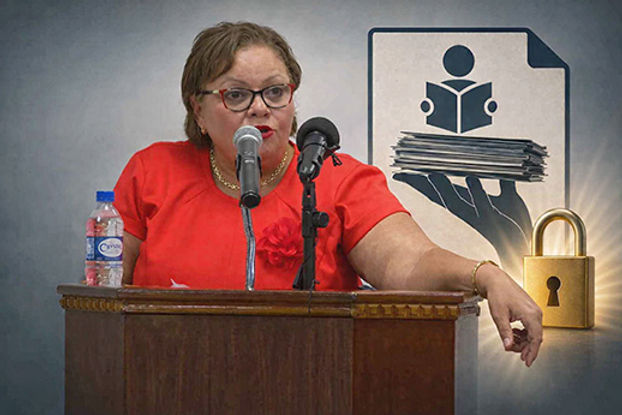
During a press briefing held by the United Democratic Party (UDP) on Tuesday, Belize’s Opposition Leader Tracy Taegar-Panton launched sharp criticism of the sitting Briceño administration, accusing it of rolling back on public transparency commitments. Panton pointed to local activist Jerry Enriquez’s prolonged legal battle to obtain unreleased government documents as tangible proof of the government’s growing reluctance to share public information with citizens.
Enriquez’s push for access to requested records has already garnered formal backing from Belize’s former Ombudsman, who affirmed the activist’s legal right to the documents under the country’s Freedom of Information Act. Panton emphasized that the legislation is far more than a symbolic ceremonial law: it is a binding legal mechanism created explicitly to guarantee public access to government information. “The Freedom of Information Act is not a decoration you hang on a tree. It is a legal tool,” she stated in the press conference.
The Opposition Leader argued that despite the Briceño administration’s repeated campaign promises to prioritize open governance and accountability, Belizeans from all walks of life — including working journalists, opposition representatives, and ordinary residents — are now forced to formally file Freedom of Information requests just to access basic public records that should be proactively disclosed. This shift, she noted, creates unnecessary barriers for anyone seeking insight into government operations and public spending.
Alongside calling out the administration’s lack of openness, Panton used the press conference to announce two new Freedom of Information requests filed by the UDP. The first request seeks full access to government contracts tied to entities linked to cabinet Minister Oscar Mira, while the second asks for unreleased records related to the country’s National Health Insurance programme.
Panton closed her remarks by reaffirming that transparency and accountability are non-negotiable obligations for any public government, rather than optional actions that sitting officials can choose to provide or withhold. All public institutions, she stressed, remain fully answerable to the Belizean citizens that they are mandated to serve.