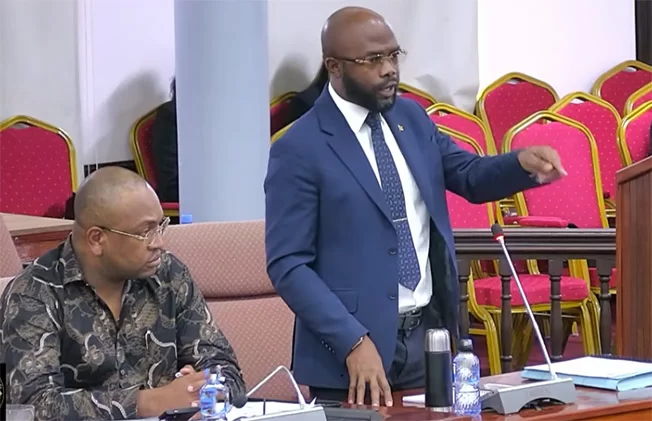
A long-simmering infrastructure dispute has sparked fierce debate in Suriname’s National Assembly, centered on a 2025 decision by then-acting Minister of Public Works and Spatial Planning André Misiekaba to withdraw an appeal in the legal case over the troubled Van ‘t Hogerhuysstraat project.
Misiekaba, who currently serves as Minister of Public Health, Welfare and Labor, told the assembly Thursday that he took on the acting public works portfolio temporarily at the president’s request back in 2025, as the post had not yet been filled by the new administration. He defended his choice to pull the appeal, arguing that the project was already a legacy crisis left by the previous administration when his government took office. At the time of the decision, the roadway had already fallen into severe disrepair, marked by large potholes that disrupted travel for local residents.
To break the years-long deadlock over the project, Misiekaba explained, the administration convened all relevant stakeholders, including contractor Baitali NV, and made the decision to withdraw the appeal based on the information available at the time. He pushed back against criticism that the government should have let the appeal proceed, noting that the judiciary is an independent body, and no official could have predicted how the High Court of Justice would rule on the case. His actions, he insisted, were taken in good faith to normalize the stalled infrastructure project and resolve a years-long problem. Misiekaba added that after current Public Works Minister Stephen Tsang took office, he took over full oversight of the case, reiterating that the current administration inherited the problem and is committed to finding a resolution, even if the process requires additional time.
But VHP parliamentarian Krishna Mathoera rejected Misiekaba’s justifications, arguing that the core issue is not how the court might have ruled, but the fallout of the appeal withdrawal decision in a democratic rule of law. She explained that when a contracting award is issued and an established company disputes the decision through the legal system, the government undermines due process by choosing to voluntarily withdraw a pending appeal, allowing the lower court ruling to take immediate effect.
Most critically, Mathoera emphasized, the administration waited a full 10 months after the appeal withdrawal to reconvene talks with all involved parties. This prolonged stagnation, she said, has created unnecessary disruptions to public services, leaving local residents to deal with the damaged roadway and the project’s ongoing uncertainty for far longer than required.
The debate also devolved into a heated verbal exchange between Misiekaba and fellow parliamentarian Van Samson. Misiekaba claimed Van Samson had implied he knew ahead of time the government would have won the appeal if it had proceeded, a claim Van Samson immediately denied, stating he never made any such assertion.
National Assembly Speaker Ashwin Adhin stepped in to de-escalate the exchange, urging both government representatives and lawmakers to stick strictly to verifiable facts. Adhin intervened specifically to prevent the ongoing budget proceedings from descending into a personal argument before the session resumed as scheduled.