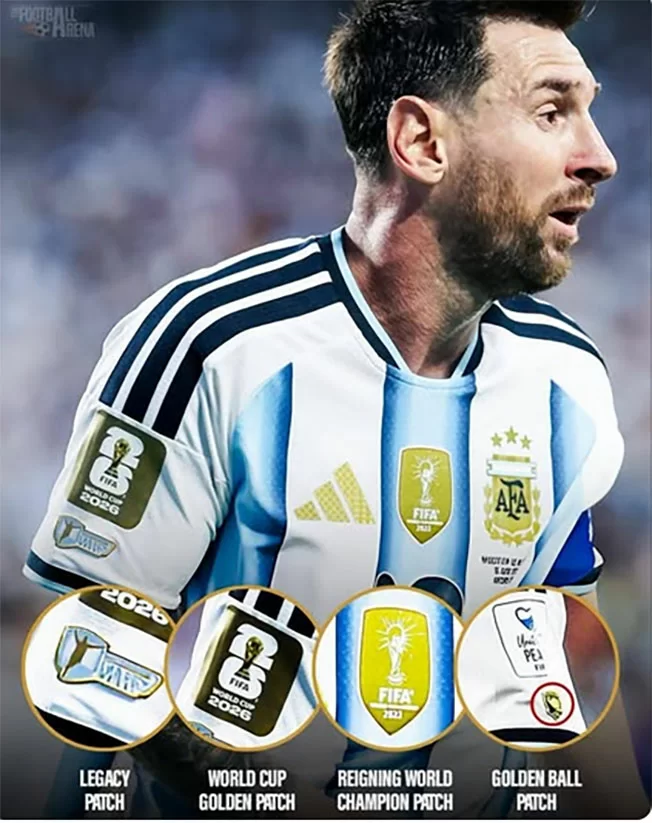
The 2026 FIFA World Cup brings far more than just 48 teams competing for the sport’s most coveted trophy – it introduces a groundbreaking new tradition that turns every player’s jersey into a walking narrative of football history. For the first time in World Cup history, FIFA has approved a series of specialized commemorative emblems that players wear on their sleeves, small in size but profound in meaning, each marking a unique milestone in a player’s or nation’s football journey.
The most exclusive of these honors is the Legacy Patch, an award only granted to players who have stepped onto the pitch in five or more World Cup final tournaments. This elite group includes global icons such as Lionel Messi, Cristiano Ronaldo, and Luka Modrić, but Messi holds a singular distinction: the Argentine superstar is the first player in World Cup history to compete at six different editions of the tournament, spanning an incredible 20 years of World Cup history. Far from just decorative stitching, the Legacy Patch stands as a tribute to extraordinary longevity, consistent elite performance, and unrivaled international class.
For first-time World Cup competitors, the new Debut Patch celebrates the realization of a lifelong dream. Every player making their first World Cup appearance in this tournament wears this special badge, a visible marker of years of sacrifice, qualifying battles, injury comebacks, setbacks, and relentless hard work that have led to their first minutes on the world’s biggest football stage. This honor extends not just to individual debutants from established football nations, but also to players from debutant countries including Jordan, Curaçao, Uzbekistan, and Cape Verde, marking their nations’ first ever appearance at a World Cup finals.
Individual past excellence is also recognized with specialized honors. The Golden Boot Patch is worn by former World Cup top goal scorers, reminding fans of their status as the most clinical finishers in a previous tournament. Similarly, former Golden Glove winners, awarded to the best goalkeeper of a past World Cup, carry their own dedicated badge. For supporters, these badges provide an immediate, visible connection to the historic achievements that have shaped the tournament’s legacy, letting them identify standout players from past editions at a glance.
Commemoration extends beyond individual players to the historic achievements of competing nations. Countries that have previously won the World Cup now wear a gold version of the official 2026 World Cup logo on their kits, highlighting their rich football heritage. This elite group includes Argentina, Brazil, Germany, France, Spain, Italy, England, and Uruguay, with Argentina also carrying an additional gold champion badge as the current defending World Cup title holder. The gold logo, positioned on the right sleeve, immediately distinguishes past champions from nations that have never lifted the trophy.
No player’s kit at this tournament carries as much symbolic weight as Lionel Messi’s. The Argentine captain wears multiple commemorative badges at once: the historic Legacy Patch for his unprecedented sixth World Cup appearance, Argentina’s gold champion badge, the gold World Cup logo marking his nation’s past titles, and a special honor recognizing his status as the best player of the 2022 Qatar World Cup. What could have been just another match jersey becomes a concise visual summary of one of the most remarkable international careers in the entire history of football.
Where traditional football jerseys once served the simple purpose of distinguishing teams and nations, the 2026 World Cup has reimagined the garment as a carrier of stories. Every badge represents a distinct chapter in global football history: the first-time debutant finally turning a childhood dream into reality, the former top scorer returning to chase new goals, the legendary goalkeeper who once dominated the penalty area, and the living legends stepping onto the World Cup stage for what may be their final appearance.
Many see this small, thoughtful innovation as the most meaningful improvement of this 2026 World Cup – not new technology, not bigger stadiums, not even the expansion to 48 teams, but a subtle, powerful recognition that every jersey has a story worth telling.