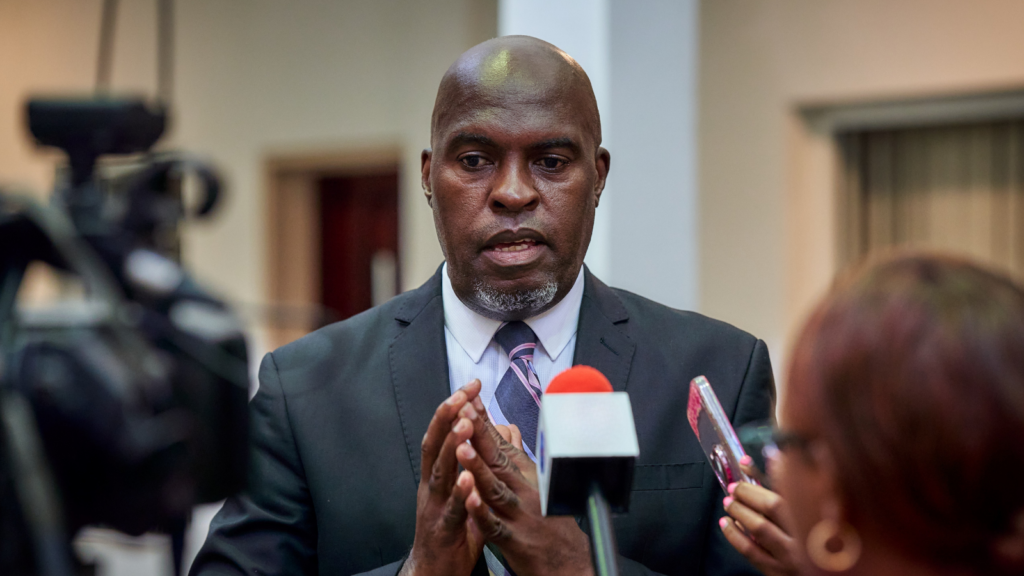
Barbados’ Minister of Legal Affairs and Criminal Justice Michael Lashley has moved to ease mounting anxiety among local legal practitioners over the administration’s plan to launch two dedicated gun courts, confirming that all staffing and operational frameworks for the initiative have already been finalized.
Speaking on the floor of the Senate Wednesday while introducing the Supreme Court of Judicature Amendment Bill, Lashley emphasized that the new specialized tribunals will be fully resourced from their opening day, with all personnel hired from outside the country’s existing overstretched criminal justice system. “I have heard concerns from some practitioners about how we will deliver fast-tracked rulings, but this is a specialized court built for speed,” Lashley stated. “We have already secured approval to appoint two external judges who have dedicated availability to handle these cases exclusively. Beyond the bench, we will also bring on two additional legal assistants, four court marshals, and four probation officers, all from outside the current system. Four prosecuting attorneys are already on standby and ready to begin work as soon as the courts launch.”
Lashley explained that procedural adjustments have also been made to cut down on unnecessary delays, with pre-sentence reports prepared as soon as an accused person enters a guilty plea, eliminating the need for repeated case adjournments.
A prominent criminal defence attorney before joining the government in February, Lashley also pushed back against criticism from fellow lawyers, arguing that many opponents of the plan have failed to put forward actionable solutions to the country’s decades-long problem of sprawling case backlogs. He challenged legal practitioners to propose concrete adjustments, such as shifting lower-level non-violent offences to magistrate courts to free up High Court capacity. For example, he noted, indecent assault cases that do not involve minor victims and common law escape from custody charges could easily be handled at the lower court level, while the most serious offences would remain in the High Court. He also pointed out that no practitioner had proposed the early guilty plea system that the new gun courts are set to implement.
Lashley underscored the urgent need for the specialized courts by pointing to the country’s worsening firearm crime crisis. He revealed that 23 of the 27 murders recorded in Barbados so far this year have been linked to illegal guns, and police have already seized 51 unregistered firearms since January. Last year alone, law enforcement seized more than 80 illegal weapons and 3,309 rounds of ammunition, generating hundreds of new pending cases that will add to existing court loads. “This means that there are cases to be done, cases to be fast-tracked, cases to be tried,” Lashley said.
Thanks to a recent collaborative effort between an independent consultant and the Barbados Police Service’s prosecution department, hundreds of backlogged case files from 2022 to 2024 have already been processed and prepared for trial: 672 files have been completed and submitted to prosecuting officers, Lashley confirmed. Ready cases are already lined up to fill the dockets of the new courts from launch: four cases from the start of the year are trial-ready, three more from March, and 11 from April, he said, dispelling claims the new courts would sit idle without a pipeline of cases.
Drawing on successful regional precedent, Lashley noted that Jamaica’s specialized gun court achieved significant reductions in case backlogs, and Barbados will adapt that proven model to fit local needs. Under the Barbados plan, one of the two new courts will focus exclusively on clearing the existing backlog of gun crime cases, while the second will handle all new firearm offences filed from 2026 onward.
The minister’s goal is to ensure all gun-related cases go to trial within six months of being filed, a timeline he argues will both cut gun crime in the country and protect the rights of defendants. “A man who is on bail for firearm possession or a related gun offence will not be able to reoffend freely if his case is heard within four or five months,” Lashley explained. “Speedy trials lead to reduced criminal activity because we get dangerous offenders off the streets faster. At the same time, this approach upholds a defendant’s right to a trial within a reasonable time without unnecessary delay, and it also protects the rights of victims who have been waiting for justice.”
Lashley added that the Barbados Police Service will receive additional resources to strengthen evidence gathering and case management in the prosecution department. New criminal procedural rules will also be rolled out in the near future to require both prosecution and defence teams to be fully prepared before a trial begins, eliminating the last-minute delays that have bogged down existing court proceedings. “All the speculation from some lawyers about new delays and backlogs is unfounded, because the procedural rules that will prevent these issues are already coming,” he said.
To address additional concerns about witness safety, Lashley confirmed that the Criminal Proceedings Act will soon be officially proclaimed, bringing into force new protections for witnesses that include the option to safeguard their identities during proceedings, a change that addresses longstanding concerns about intimidation in the High Court.