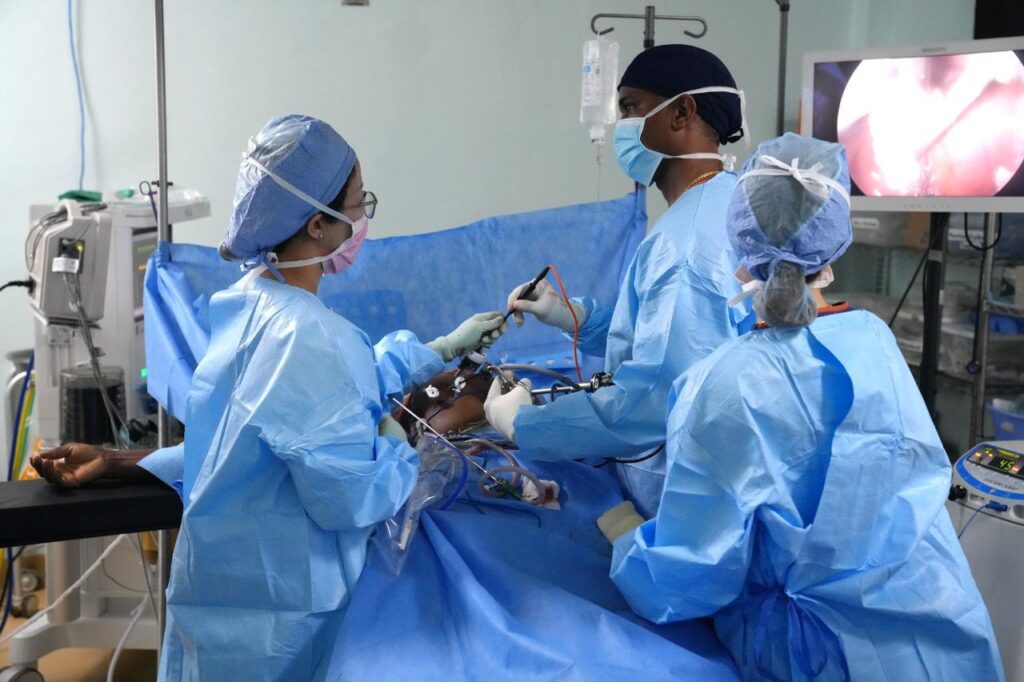
In a landmark achievement for Jamaica’s public healthcare system, Mandeville Regional Hospital (MRH), located in the country’s Manchester parish, has recorded a historic first: the nation’s inaugural scar-free minimally invasive gynecological surgery using the cutting-edge Vaginal Natural Orifice Transluminal Endoscopic Surgery (vNOTES) technique. The groundbreaking milestone was achieved during a three-day targeted surgical outreach held between June 9 and 11, 2026, forged through a partnership between local MRH clinicians and volunteer specialist surgeons from the Jamaica Awareness Association of California (JAAC), a U.S.-based nonprofit that runs annual capacity-building medical missions across the island.
Unlike traditional gynecological and abdominal procedures that require external incisions through the abdominal wall, vNOTES enables surgical teams to complete operations entirely through the vaginal canal, using specialized miniature instruments and a high-definition endoscopic camera. This approach eliminates any visible external scarring, reduces post-operative pain, cuts down on recovery time, and lowers the risk of post-surgical infection, making it a transformative option for Jamaican patients.
Over the course of the mission, the combined U.S.-Jamaican clinical team successfully completed 21 complex advanced procedures spanning multiple surgical specialties. These procedures included three variations of advanced laparoscopic hernia repair (Transabdominal Preperitoneal, Totally Extraperitoneal, and Intraperitoneal Onlay Mesh), laparoscopic gallbladder removals, and a range of minimally invasive gynecological surgeries — including hysterectomies, bilateral salpingectomies, and ovarian cyst excisions, with the gynecological cases marking the first vNOTES applications in the country.
Dr. Ashok Kotagiri, Senior Resident in MRH’s Department of Surgery, emphasized that the procedures completed during the mission represented a step up in complexity from the standard operations regularly performed at the facility. “Even in the United States and across Europe, not all practicing gynecologists have the specialized training and skills required to perform this type of advanced laparoscopic gynecological surgery,” Kotagiri noted. “We are incredibly proud that our team at MRH is the first in Jamaica to master and deploy this technique.”
Dr. Sharon Shiraga, Associate Professor of Surgery at the University of Southern California and a long-serving volunteer physician with JAAC, explained that the annual mission’s core goals extend far beyond direct patient care: its central mission is to build long-term local capacity through hands-on, mentorship-driven training for Jamaican clinicians. “We’re here to help our local colleagues sharpen their laparoscopy skills across a range of advanced procedures, from hernia repairs to gallbladder surgeries and beyond,” Shiraga explained. She highlighted a standout moment from the mission, where a junior resident successfully led a complex procedure with guided mentorship from the volunteer team, noting that the immersive experience helped local clinicians build confidence in their ability to independently perform advanced techniques moving forward.
For Dr. Toshikah Wheatley-Williams, Senior Resident in Obstetrics and Gynaecology at MRH, the introduction of vNOTES represents nothing less than a paradigm shift for women’s healthcare in Jamaica. “This is going to be a total game changer for our patients,” she said. “Beyond the inherent benefits of minimally invasive surgery, women will be able to return to their daily lives, work, and family responsibilities far faster than with traditional open or even standard laparoscopic procedures.”
In addition to training and clinical work, the JAAC team made a substantial material contribution to expanding MRH’s care capacity, donating specialized laparoscopic and surgical supplies valued at approximately 5 million Jamaican dollars. The donated equipment and consumables will enable the hospital to continue offering advanced procedures to low-income patients who would otherwise be unable to afford the specialized supplies required for these life-changing operations, cementing the mission’s long-term impact on Jamaican healthcare access.