On June 3, 2026, the Inter-American Institute for Cooperation on Agriculture (IICA) convened its Annual Accountability Seminar in Dominica, bringing together a diverse cohort of cross-sector stakeholders to reflect on the institution’s 2025 work in the country and lay out a roadmap for expanded support to local farmers, agribusiness operators, and rural communities. Carried out under the central theme “From Local Fields to Regional Markets: Strengthening Food Security through Trade, MSMEs and Accountability”, the event served as a critical platform for reviewing past achievements, aligning on upcoming technical cooperation priorities, and centering the growing impact of agricultural micro, small, and medium-sized enterprises (MSMEs) on reinforcing Dominica’s food systems and national economy.
Stakeholders in attendance spanned government agencies, financial institutions, international development bodies, farmer associations, agro-processing firms, and independent primary producers. Collaborative partnership and coordinated collective action to advance Dominica’s agricultural sector emerged as core themes running through all seminar discussions.
In his opening address to participants, Gregg Rawlins, IICA’s Representative for the Eastern Caribbean States, underscored the institute’s ongoing work to help local agricultural MSMEs expand their operational footprint and secure improved access to regional consumer markets. Rawlins spotlighted the AgriMSE Business Development and Intra-Regional Market Integration Project, a joint initiative delivered in partnership with the Caribbean Development Bank (CDB) that forms a core part of IICA’s long-term development strategy for the sector.
“This project forms part of IICA’s ongoing commitment to embedding the AgriMSE sector more deeply into national economies, and helping producers position their goods effectively within mainstream domestic marketing and distribution channels, as well as cross-border intra-regional trade,” Rawlins explained.
The initiative is structured around three core strategic goals: removing barriers to intra-regional marketing and export activity, boosting the production and operational efficiency of small agricultural enterprises, and expanding their access to formal financing and new investment opportunities.
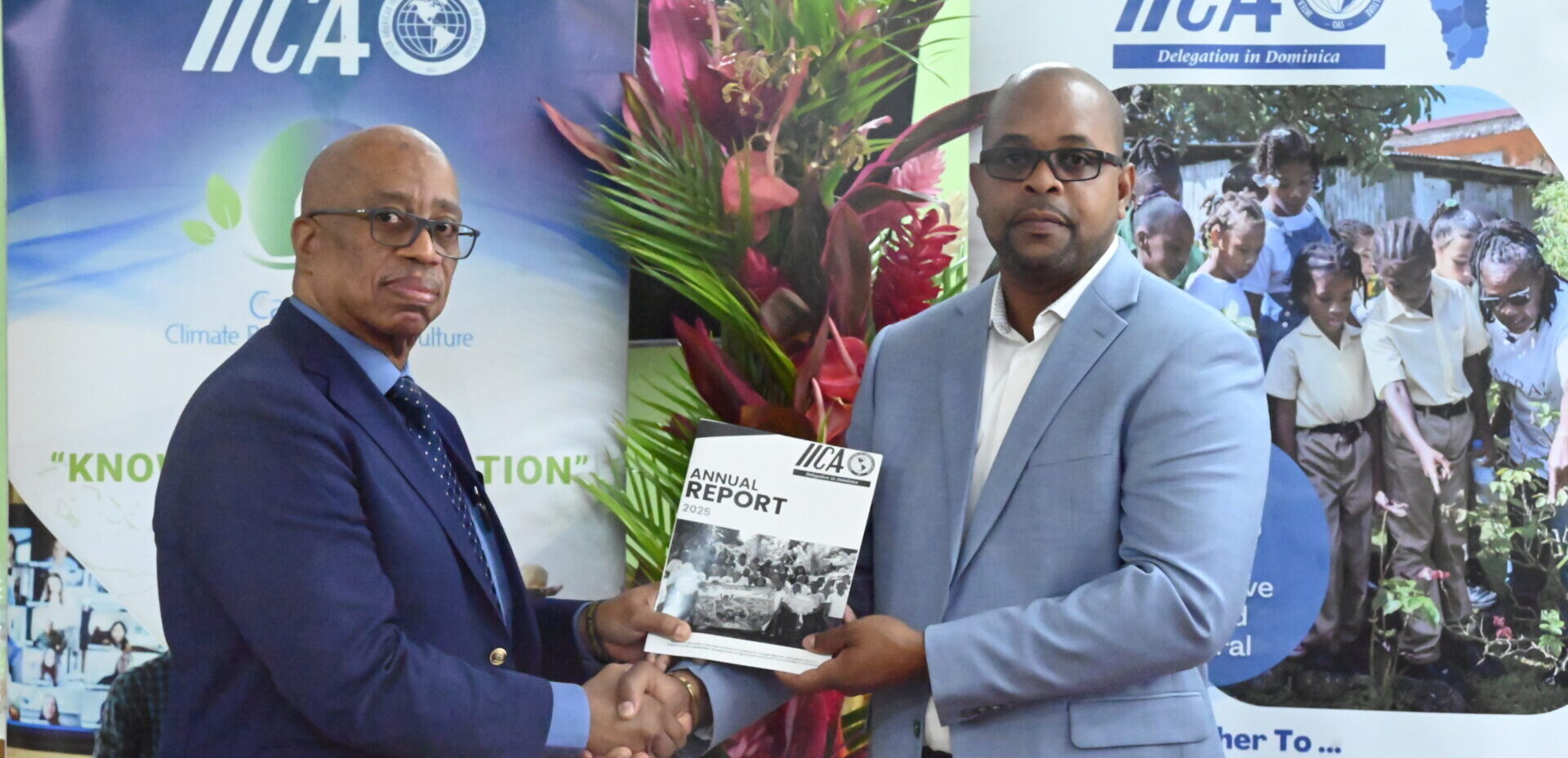
Technical Specialist Anthony Cyrille led a comprehensive review of IICA’s 2025 programming in Dominica, walking attendees through key milestones achieved over the past 12 months and detailing proposed technical cooperation agendas for the coming year. A highlight of the formal proceedings was the official handover of IICA’s full 2025 Annual Report to Honourable Roland Royer, Minister for Agriculture, Fisheries, Blue and Green Economy of Dominica.
Minister Royer framed the annual report as more than a record of completed activities, noting that “today, as we receive the 2025 Annual Report, we do not merely see a document of activities completed, but a testament to the enduring partnership between IICA and the Government of Dominica, a partnership that continues to generate tangible benefits for our farmers, fishers, agro-processors, rural communities, women and youth.”
Royer also recognized IICA’s contributions to a range of foundational agricultural initiatives across the country, including sustainable livestock development programs, the regional white potato development project, high-quality seed production schemes, and specialized training in seed management and climate disaster preparedness. He particularly praised the institute’s consistent focus on supporting women and young people working in the agricultural sector, adding that “the future of agriculture belongs to innovation, technology and youth.”
The seminar closed with a stakeholder panel discussion that unpacked the most pressing opportunities and persistent challenges facing agricultural MSMEs across Dominica. Representatives from the domestic banking sector, government agencies, and producer groups collaborated to identify actionable, practical strategies to strengthen the sector’s contributions to national food security, inclusive job creation, and equitable rural development. Panellists included Terri Henry-Lovell, Vice President of the Dominica Herbal Business Association; Narrin Murphy, Senior Relationship Officer for Corporate Banking at National Bank of Dominica Ltd; and Micah Walter, Coordinator for Private Sector Relations, Industry, Commerce and Innovation in the Ministry of Labour, Public Service Reform, Social Partnership, Entrepreneurship and Small Business Development.
In a post-seminar press statement, IICA reaffirmed its long-term commitment to partnering with the Government of Dominica and local stakeholders to build a more resilient, innovative, and globally competitive agricultural sector. The institute noted that its ongoing work will remain focused on advancing programs that support small business entrepreneurship, expanded market access, climate resilience, and inclusive sustainable growth across rural Dominica.