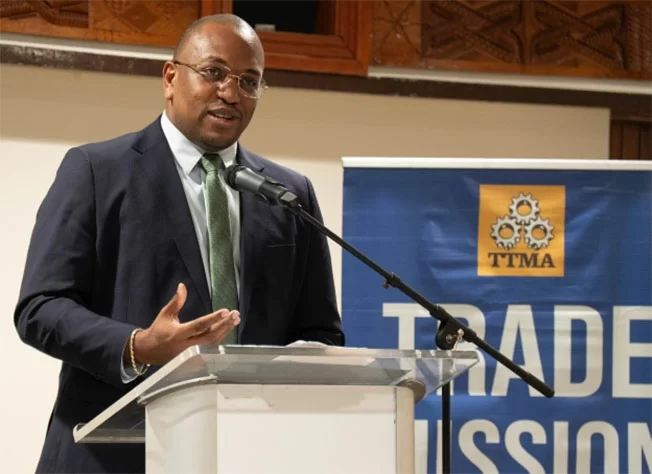
At a recent networking event co-hosted by the Suriname-Guyana Chamber of Commerce (SGCC) and the Trinidad and Tobago Manufacturers’ Association (TTMA), Suriname’s Minister of Foreign Affairs, International Trade and Cooperation Melvin Bouva has highlighted the untapped potential of complementary economic strengths across three Caribbean nations to drive inclusive regional growth and cross-border entrepreneurship.
Bouva pointed to the rising economic momentum across the three countries as a unique opening to deepen bilateral and trilateral trade ties, attract greater foreign and regional direct investment, and foster new collaborative frameworks between private sector actors across the region. He emphasized that long-term, sustainable economic development cannot rely solely on individual national policy efforts — it depends fundamentally on building strong, trust-based regional partnerships that leverage each nation’s unique advantages.
The minister also extended public recognition to the SGCC and TTMA for their ongoing work in bridging private sector communities across Suriname, Guyana, and Trinidad and Tobago. According to Bouva, the strong turnout of entrepreneurs and industry representatives from a wide range of sectors at the event reflects a growing consensus across regional business communities that cross-border collaboration is a prerequisite to fully unlocking shared economic opportunities.
Bouva further outlined Suriname’s growing strategic focus on economic diplomacy as a core tool for advancing national development. Under this strategy, the country is actively expanding and deepening economic ties with partners both within the Caribbean region and across the globe, with key existing and emerging partnerships in the broader Caribbean, South America, Europe, and North Africa, he noted.
Turning specifically to cooperation between Suriname, Guyana, and Trinidad and Tobago, Bouva broke down the complementary strengths each nation brings to the table. Trinidad and Tobago boasts robust, well-established manufacturing and energy sectors, while Guyana is currently experiencing one of the fastest economic growth rates in the Western Hemisphere. Meanwhile, Surinamese private firms are increasingly integrating into these ongoing growth dynamics across the region, taking on new roles in cross-border projects and supply chains.
“Together, our nations hold complementary strengths that can form the foundation of mutually beneficial partnerships that lift all our economies,” Bouva stated.
The minister argued that regional cooperation should extend far beyond just expanding bilateral trade volumes. He called for increased joint cross-border investment initiatives, expanded knowledge sharing between industry and academic stakeholders, deeper technological collaboration, and the intentional development of integrated regional value chains that strengthen the global competitiveness of Caribbean enterprises across all sectors.
Bouva concluded by stressing that the long-term prosperity of the entire Caribbean region will depend on how successfully governments and private sector actors can build durable, sustainable collaborative frameworks. “The future prosperity of our region will not come from isolated, individual national efforts. It will come from meaningful cooperation between governments and businesses that recognize the inherent value of cross-border partnership,” he said.
The networking event drew attendees from a diverse array of sectors, including manufacturing, logistics, construction, infrastructure development, energy, agriculture, technology, education, and professional services. Members of the international diplomatic corps based in Suriname also participated in the accompanying reception.