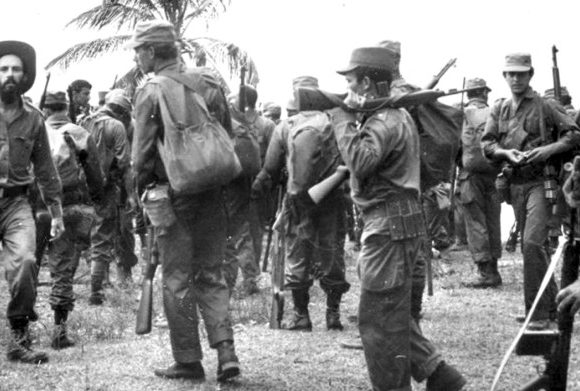
Sixty-seven years after the landmark Constanza, Maimón, and Estero Hondo expedition touched Dominican soil, this defining moment in the nation’s fight for democratic rule remains a cornerstone of the country’s modern political history. What began as a coordinated armed incursion against the long-standing authoritarian regime of Rafael Leonidas Trujillo ultimately failed as a direct military operation, but its legacy sparked the popular opposition that would topple Trujillo’s decades-long dictatorship years later.
Decades after the event, historians and storytellers have preserved the memory of the expeditionaries’ patriotic mission through published histories, oral anecdotes, and investigative journalistic work, cementing the uprising’s role as the catalyst that restored Dominican democracy. On the afternoon of June 14, 1959, a modified Curtiss C-46 cargo plane rolled down a runway in El Aguacate, Cuba, carrying 54 armed fighters toward the Dominican Republic. To evade detection by Trujillo’s border forces, the aircraft had been repainted to match the colors and official insignia of the Dominican Air Force, with Captain Juan de Dios Ventura Simón – a defector from Trujillo’s own Air Force – at the controls.
Leading the ground operation was Dominican commander Enrique Jiménez Moya, at the head of a multinational coalition of volunteers committed to ending Trujillo’s 29-year authoritarian rule. Fighters from Cuba, Venezuela, Puerto Rico, Spain, the United States, and Guatemala joined Dominican rebels, uniting disparate ideological backgrounds and personal circumstances around a single shared goal of ousting the dictator. The airborne insertion was only one part of a far larger coordinated plan: two speedboats, the *Carmen Elsa* and *Tinima*, had departed a day earlier from La Chiva dock in Nipe Bay, Cuba, carrying 144 additional expeditionaries scheduled to land on June 14 at two northern Dominican coastal sites, Maimón and Estero Hondo. However, a combination of internal sabotage and severe bad weather delayed the boats’ arrival by six full days, forcing them to miss the planned coordinated landing.
Despite the setback to the full plan, the C-46 touched down on schedule at a small remote airstrip outside Constanza. Trujillo’s garrison soldiers stationed nearby had no advance warning of the incoming flight, and the initial confusion among defending forces played into the rebels’ hands. After a brief firefight with a local patrol that left several soldiers and one officer dead, the expeditionaries unloaded their gear and slipped off the airstrip as the plane returned to Cuba. Back in the capital of Santo Domingo, Trujillo moved quickly to crush the incursion, deploying nearly 3,000 ground troops supported by truck convoys and air support. By dawn on June 15, Constanza had been turned into a war zone, with regime aircraft carrying out continuous bombing runs; the rebels were forced to retreat into the surrounding mountains to evade the assault.
Six days behind schedule, the two expeditionary speedboats finally reached Dominican shores. The *Carmen Elsa* landed at Maimón under the command of José Horacio Rodríguez, while the *Tinima* put ashore at Estero Hondo led by José Antonio Campos Navarro. Trujillo’s military had already prepared for the delayed landing, and an additional 3,000 troops backed by air and ground fire repelled the incursion, leaving no survivors from the maritime expeditionary force. After suppressing the uprising, the Trujillo regime launched a deliberate propaganda campaign claiming that the invasion had been defeated not by its professional military, but by ordinary Dominican peasants armed only with machetes, clubs, and hand-thrown stones. The regime built this narrative into a massive public relations push, producing heroic folk songs, merengues, poetry, public rallies and competitions to celebrate the supposed popular victory over the rebels. But the truth of the aftermath was far grimmer: dozens of captured expeditionaries were secretly taken to Trujillo’s torture facilities and extrajudicially executed.
Only a tiny handful of rebels survived the crackdown: three Dominican fighters, Poncio Pou Saleta, Mayobanex Vargas, and Francisco Medardo Germán, along with two Cuban volunteers – Delio Gómez Ochoa, a veteran of the Cuban Sierra Maestra insurgency, and teenage fighter Pablito Mirabal. While the 1959 expedition was a total military defeat, it reshaped the future of Dominican opposition politics as a powerful symbolic spark. The brutal, indiscriminate repression the regime unleashed against the uprising and its sympathizers generated widespread national outrage, amplifying deep existing discontent with Trujillo’s authoritarian rule.
In the months following the incursion, a small group of young Dominican opponents began organizing secretly, inspired by the expeditionaries’ sacrifice. Led by Manolo Tavárez Justo and Minerva Mirabal, the group named itself after the June 14 uprising, founding the 14 June Revolutionary Movement (1J4). Within just a few years, the movement grew into one of the most powerful anti-regime political forces in the country, playing a critical role in the eventual collapse of Trujillo’s dictatorship. To honor the expeditionaries’ legacy, the Dominican government passed Law 264-97, which officially designated June 14 as the Day of the Immortal Race, and a mausoleum at the Center of Heroes in Santo Domingo now holds the remains of the fallen fighters, preserving their memory for future generations.