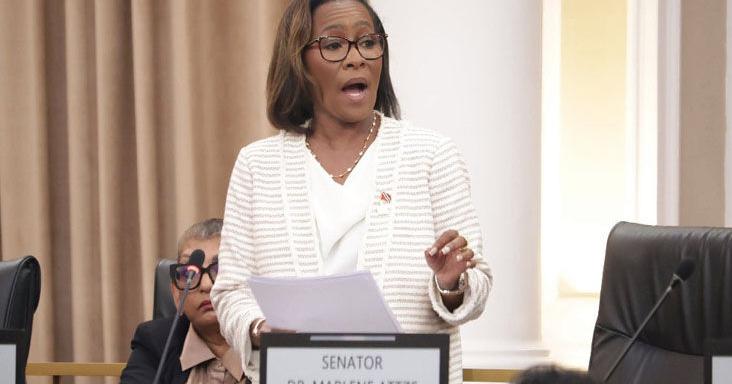
During Tuesday’s Senate debate on the 2026 Finance Bill, independent Senator Dr. Marlene Attzs has drawn policymakers’ attention to underaddressed risks stemming from the legislation’s wide-ranging package of increased fines, higher fees, stiffer penalties, and expanded compliance mandates. While she concedes that many individual provisions in the bill, which amends more than 20 separate existing laws, are justifiable on their own merits, Attzs argues that the cumulative impact of rolling out dozens of new obligations at once risks placing unbearable additional strain on households already struggling with cost-of-living pressures and small businesses operating on thin margins.
Attzs emphasized that ordinary citizens and economic actors do not experience public policy in isolated chunks; they feel the combined weight of every new tax, surcharge, filing requirement, and compliance rule layered on top of existing obligations. “Every new requirement may appear manageable when considered alone, but when stacked one atop another, they create a cumulative burden that ripples through every part of the economy, raising business operating costs, housing costs, and ultimately the final prices consumers pay,” she explained.
To illustrate her point, Attzs pointed to Clause 30 of the bill, which raises licence fees and penalties under the Spirits and Spirit Compounds Act. Cost increases imposed at early stages of supply chains do not stay confined to regulated entities, she noted, instead passing through wholesale and retail markets to land on end consumers. She further warned that policymakers often fail to distinguish between the legal incidence of a new charge, which falls on the entity legally required to remit payment, and its economic incidence, which often shifts to the most vulnerable groups that lack the bargaining power to absorb extra costs.
Beyond cumulative cost concerns, Attzs also questioned the core logic behind widespread penalty increases across sectors including gambling, tobacco, pesticides, and forestry. While she acknowledged the Finance Minister’s argument that penalties must be substantial enough to deter unlawful activity, she pushed back on the assumption that harsher sanctions alone automatically translate to higher compliance rates. Effective regulatory systems, she argued, rest on three equally important pillars: public education, accessible facilitation for regulated actors, and consistent enforcement. Stiffer penalties will not improve outcomes if compliance pathways are convoluted, public information is scarce, and regulatory agencies lack the resources to carry out consistent, fair enforcement. In that scenario, penalty increases exist only on paper, she said.
Attzs highlighted Clause 15 as a key example of this gap: the provision doubles the maximum penalty for unapproved copra product manufacturing from $4,000 to $8,000, drawing public concern over impacts on small-scale producers of homemade coconut oil and vinegar. While Attzs agreed that regulatory product standards are necessary, she pointed out that most producers affected by this change are not large corporations with in-house compliance teams and legal counsel. They are often cottage industry operators, rural households, women-led micro-enterprises, and people working to supplement low household incomes.
She pressed the government to outline what support measures will be put in place to help these small-scale operators transition into formal compliance with regulatory requirements. “If we are increasing penalties for non-compliance, we have an obligation to build accessible pathways to compliance at the same time, especially for groups with limited resources and limited familiarity with complex regulatory processes,” Attzs said.
Closing her remarks, Attzs posed a core question for legislators: “Are we trying to build a culture of compliance, or are we trying to impose a culture of punishment?” Effective legislation, she argued, requires more than just larger fines and harsher sanctions. It depends on capable, resourced institutions, clear and accessible regulations, public trust, and practical support to help stakeholders meet requirements. To that end, she proposed targeted adjustments including phased implementation of new rules, widespread public education campaigns, warning notices for first-time minor offenders, and graduated penalties that align with the severity of the violation. These measures, she said, would foster long-term compliance rather than simply imposing disproportionate punishment on the most vulnerable.