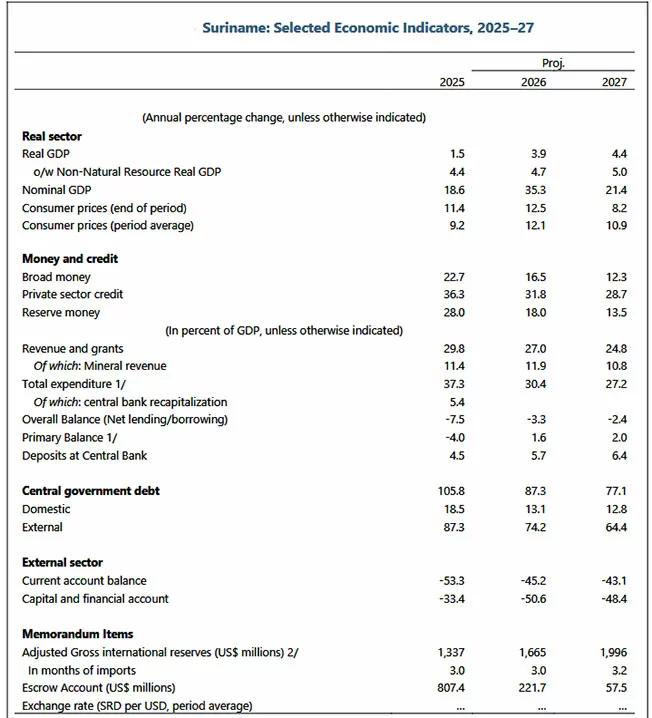
Suriname’s Minister of Finance and Planning Adeline Wijnerman has reacted positively to a new International Monetary Fund assessment that confirms the South American nation’s economy has continued to stabilize in recent months, while issuing a sharp warning that the country must remain vigilant against global headwinds and ramp up domestic production to insulate its economy from future shocks.\n\nIn an official statement released via the Communications Service of Suriname, Wijnerman emphasized that the IMF’s latest report validates that the structural economic reforms implemented by the administration over the past several years are now delivering tangible results. Key indicators have shown notable improvement: inflation has fallen significantly, the national exchange rate has held relatively steady, and business and consumer confidence in the economy has grown gradually.\n\nDespite these encouraging gains, the minister stressed that current stability does not guarantee long-term, sustainable economic growth. “Things are good right now, but we should not celebrate prematurely or simply cross our fingers and hope for improvement,” Wijnerman said, cautioning against overconfidence.\n\nShe pointed out that Suriname’s economy remains highly sensitive to shifting international developments, which continue to put broad pressure on the global economy amid ongoing geopolitical tensions, volatile commodity prices and widespread uncertainty across global financial markets. On top of external risks, domestic factors including ongoing wage negotiations and shifting domestic price trends can also impact inflation and exchange rate stability, adding further layers of vulnerability.\n\nOne of the most persistent weak points in Suriname’s economy, Wijnerman noted, is its heavy reliance on imported goods, with fuel imports in particular placing consistent strain on public finances. To shield consumers from skyrocketing global oil prices, the government has implemented a fuel price cap, but this policy comes at a cost: it forces the state to forgo revenue that could otherwise be allocated to critical public infrastructure and economic development investments.\n\nTo address this dependence, Wijnerman is pushing for accelerated development of domestic productive sectors, most notably agriculture and rice cultivation. Suriname holds significant untapped potential to expand local production, create new formal jobs for its population and cut its import exposure, the minister argued. She pointed to recent activity at the nation’s agricultural trade fair as evidence of the growing opportunities available in the domestic agricultural sector.\n\nWijnerman clarified that building out these sectors is not a responsibility for the government alone; private entrepreneurs and domestic and foreign investors will play a central role in driving growth. The government’s core task is to put the right enabling conditions in place, while she acknowledged that securing affordable access to financing remains one of the biggest hurdles for local producers looking to scale operations.\n\nLooking ahead to projected oil and gas revenues that Suriname expects to collect in coming years, Wijnerman warned against the pitfalls of overreliance on the extractive sector. “We cannot afford to simply wait around for oil money to come in,” she said. “We need to build up other sectors right now, so we have a strong foundation to grow from when oil production eventually declines.”\n\nIn line with this vision, the minister highlighted that tourism, agriculture, and a broad range of other non-extractive entrepreneurial sectors must play key roles in Suriname’s future economic growth. Long-term resilience for the Surinamese economy depends on consistent, intentional economic diversification, she concluded.