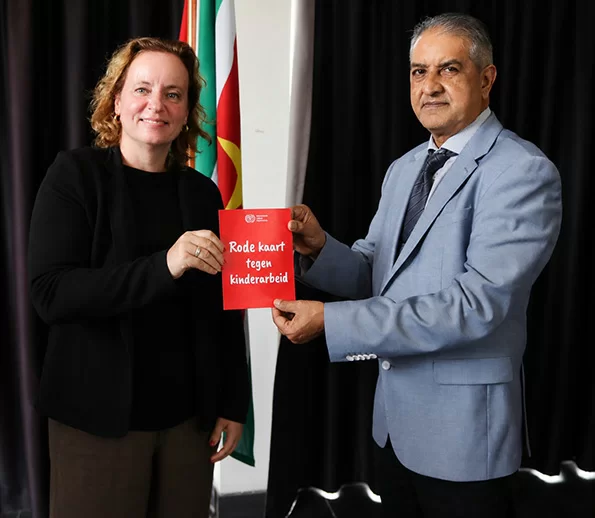
On June 12, the annual World Day Against Child Labor, Suriname has launched a nationwide call to action, urging all sectors of society to show a symbolic ‘red card’ to the exploitative practice of child labor. Centered around the campaign theme ‘Red Card Against Child Labor’, this initiative aims to galvanize public attention around protecting children from economic exploitation and work that undermines their physical, cognitive and social development.
In an official press statement released by the Welfare and Labor Directorate under Suriname’s Ministry of Health, the symbolic red card is defined as a clear, uncompromising rejection of all forms of child labor that strip children of their right to education, stunt their growth, and rob them of the carefree childhood every young person is entitled to. A public photograph released alongside the announcement shows Suriname’s Vice Minister of Health, Welfare and Labor Raj Jadnanansing joining a senior official from the International Labour Organization (ILO) in holding up a red card to mark the campaign launch.
To turn this public commitment into actionable policy, the Surinamese government already took concrete legislative steps in May of this year to establish a formal commission mandated under Article 16 of the country’s Law on Employment of Children and Young Persons. This newly formed commission will conduct in-depth field investigations into the social circumstances of children trapped in child labor, then deliver evidence-based recommendations for targeted support to affected children and strengthen assistance for vulnerable families at the root of the issue.
Parallel to the commission’s establishment, representatives from Suriname’s government, employer associations, labor unions, and civil society organizations have already reached consensus on two draft state decrees that classify light permissible work and prohibited hazardous work for children and young persons. These new regulatory documents will flesh out the framework of the existing 2015 child labor law, closing gaps in current regulation and strengthening legal protections for children against economic exploitation.
The Welfare and Labor Directorate emphasized in its statement that eliminating child labor cannot be achieved by the government alone. It requires coordinated collective action from state institutions, private sector employers, organized labor, civil society groups, and local families. Investing in accessible quality education, expanding comprehensive social protection systems, and raising public awareness of the harms of child labor are the core strategies Suriname will leverage to further reduce child labor prevalence across the country.
World Day Against Child Labor, marked every June 12 globally, sees hundreds of awareness-raising activities hosted in countries around the world. The day serves as a global reminder that more than 160 million children worldwide still remain trapped in work that threatens their health, safety, and long-term development, requiring sustained global and national action to address the crisis.