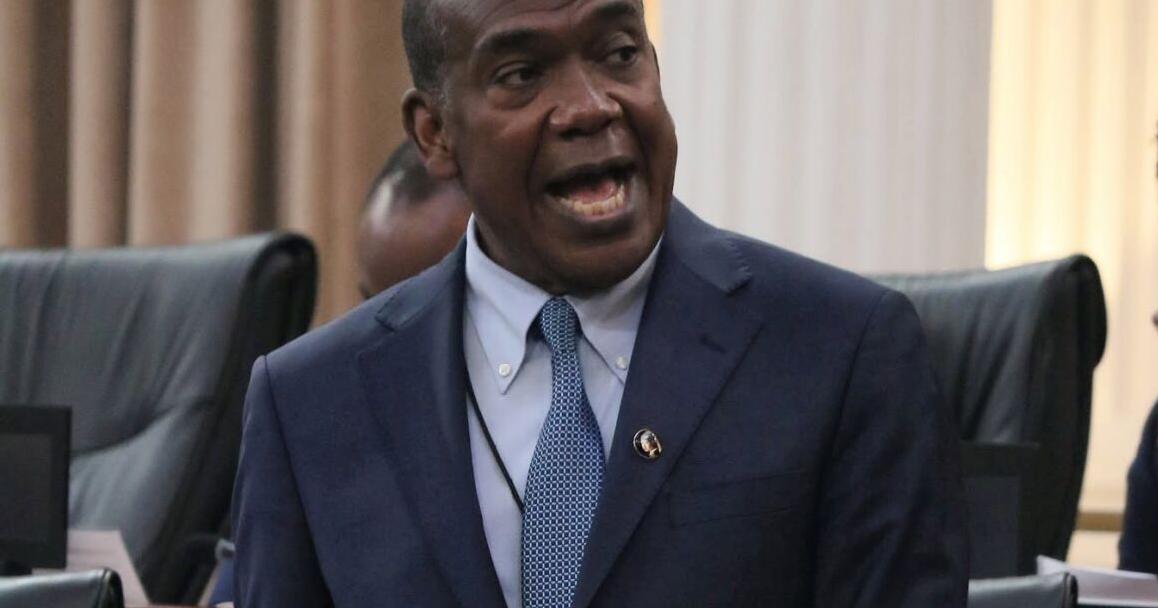
During a parliamentary sitting on Wednesday, Trinidad and Tobago Attorney General John Jeremie made a striking announcement: the United States government has revoked travel visas for multiple members of the country’s self-named elite “1%” criminal gang, a well-resourced white-collar criminal group with deep ties to the previous ruling People’s National Movement (PNM). The announcement came as Jeremie tabled a motion requesting a three-month extension of the country’s ongoing state of emergency (SoE), an anti-crime measure implemented by the current ruling People’s National Partnership led by Prime Minister Kamla Persad-Bissessar.
Jeremie explained that U.S. authorities used their advanced intelligence capabilities to assess the activities of these individuals before making the decision to revoke their visas. The Trinidad and Tobago government had no involvement in the U.S. visa action, he emphasized, but the national government retains full authority to crack down on illegal activity occurring within its borders.
In his address to parliament, Jeremie pushed back against the narrow public perception that gangs in Trinidad and Tobago are limited to working-class street organizations such as the numbered groups SIXX, Seven, and Eight. Under the country’s existing Anti-Gang Act, a gang is defined as any formal or informal grouping of two or more people that engages in criminal activity—a definition that explicitly includes the elite “1%”, he argued.
Jeremie recalled a 2017 interview with CNN personality Anthony Bourdain, where a prominent “1%” member openly described the small group as the most powerful in the country. While the individual later apologized for the offhand comment, Jeremie told lawmakers the claim was entirely accurate. For a decade under PNM rule, the “1%” grew to become one of the most well-connected, resourced groups in Trinidad and Tobago, he said, controlling large swathes of the national economy.
He highlighted the group’s systemic economic privilege: while ordinary citizens must queue at banks to access a maximum of $200 in foreign currency for travel, requiring proof of a booked trip, “1%” members access hundreds of thousands of U.S. dollars on revolving credit monthly to fund their businesses, travel, and lavish lifestyles. Jeremie alleged the group has directly funded the PNM, been revered by party leadership, and effectively taken control of the party, with opposition politicians acting as willing pawns for the elite gang.
The disclosure of visa revocations came after a journalist from Guardian Media Ltd — which Jeremie claims is owned by the “1%” — first questioned him about the reports. Jeremie initially ignored the question, but later had multiple members of the group approach him in his office to confirm their U.S. visas had been revoked.
In a hardline warning to the elite gang and all criminal groups in the country, Jeremie stated that the era of elite impunity is over. “To those persons among us who consider that their wealth allows them guarantees from prosecution, and from the attention of law enforcement bodies, we say those days are behind us. If you behave as gang members do, you shall be treated in exactly the same way that blue-collar gang members are,” he said. Whether a group calls itself the “1%” or one of the country’s known street gangs, the maximum-security Teteron Prison is waiting for those convicted of gang activity, he added.
Jeremie also issued a direct warning to group members who have targeted him and Prime Minister Persad-Bissessar, hiding behind their media holdings to launch criticism and allegedly plotting more direct action. “if, as our intelligence suggests, you have in contemplation more and direct action, the indignity of the cells at Teteron await,” he said.
The Attorney General declined to elaborate further on allegations of improper state land deals, which he said went right up to the night of the last general election, noting that the matter is currently under active investigation by the Commissioner of Police. He added that the PNM not only turned a blind eye to white-collar gang activity by the “1%”, but also failed to address growing street gang violence across the country.
Jeremie stressed that equality before the law applies to all citizens regardless of class: a violation of the law by a wealthy member of the “1%” is no different than a crime committed by a young, low-income person in the neighborhoods of Morvant or Laventille. While Trinidad and Tobago has no control over the visa action taken by its northern ally, the country’s law enforcement agencies will act on credible intelligence of criminal activity by the group, he confirmed. The government’s crackdown on all gang activity will not be deterred by threats or pushback, Jeremie added, even as he acknowledged potential personal and political consequences for himself and the Prime Minister.
Beyond the announcement of visa revocations, Jeremie made the case for extending the current state of emergency, highlighting its strong early results under the current administration compared to SoEs implemented by the previous PNM government. He cited an internal analysis from the Trinidad and Tobago Police Service’s Strategic Analytics and Intelligence Department, which evaluated three consecutive states of emergency between December 2024 and June 2026. The analysis found that SoEs implemented by the current United National Congress (UNC)-led administration were far more effective at reducing crime. The current SoE has delivered the strongest overall crime reduction outcomes, with substantial drops in violent crime, kidnappings, robberies, firearms offenses, and total reported serious crime, while murder rates have remained below the levels recorded in the same period of 2025. Jeremie noted that the country is significantly safer today than it was during what he called the “horrible years” of PNM rule.