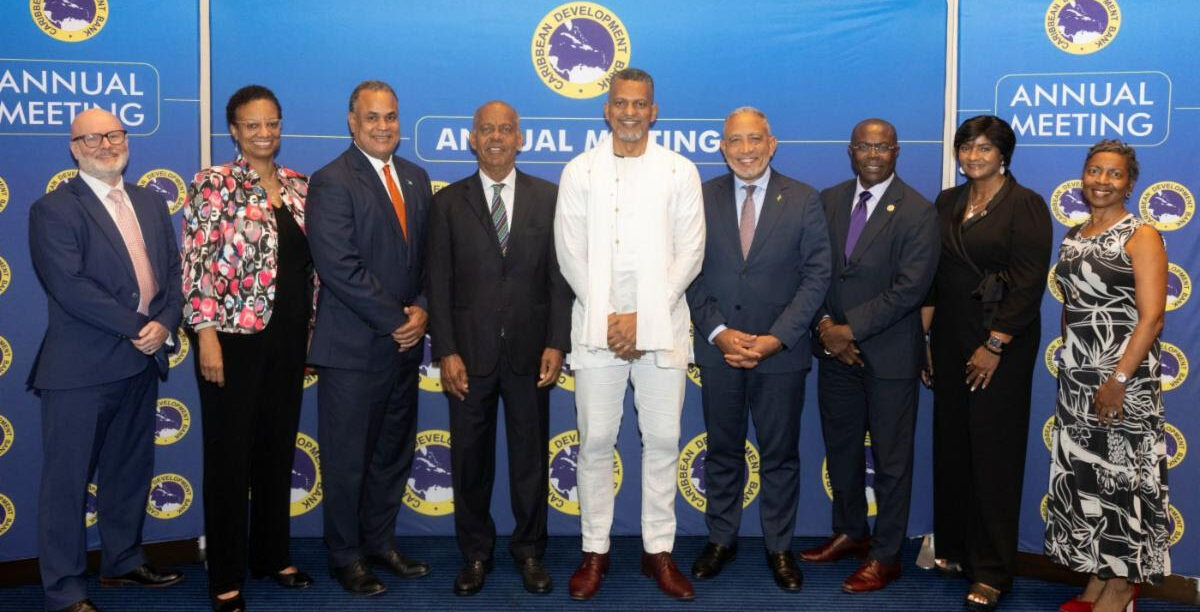
At the 56th Annual Meeting of the Caribbean Development Bank (CDB) Board of Governors, a senior regional judicial leader has made a forceful case for robust, independent judicial systems as a non-negotiable foundation for long-term, inclusive growth across the Caribbean region.
The Honorable Mr Justice Denys Barrow, a sitting judge of the Caribbean Court of Justice (CCJ), delivered this year’s William G. Demas Memorial Lecture, the 26th iteration of the annual address honoring the legacy of one of the Caribbean’s most prominent development leaders. Speaking under the official theme “Contributions of the Courts to Caribbean Development: The Enduring Importance of Strong Institutions”, Barrow centered his remarks on the often underrecognized link between effective governance institutions and equitable regional progress — a framing that aligns directly with CDB’s newly launched 10-year strategic plan, *Transforming the Caribbean for Resilience: The 2026–2035 Strategy*, which identifies institutional strengthening, youth development and climate resilience as core pillars of sustainable long-term growth.
Challenging the dominant narrow framing of development that prioritizes gross economic metrics and technical infrastructure outputs alone, Barrow argued that the ultimate goal of all development efforts must be the tangible improvement of community well-being and individual quality of life. “It is to be kept in mind, when discussing development, that it is the development of the community that must be the ultimate focus and beneficiary of our efforts and that projects, targets for growth, and methods of improvement are markers along the path to community development and not ultimate goals,” Barrow stated.
From this perspective, Barrow outlined the irreplaceable role that courts play in advancing people-centered development. By upholding public order, protecting fundamental civil and property rights, and establishing a predictable framework for social and commercial interaction, judiciaries create the enabling conditions that allow Caribbean communities and economies to thrive. A key pillar of this impact, he emphasized, is judicial independence: an independent, credible judiciary builds trust among both local citizens and international investors, as fair, efficient resolution of disputes directly supports social stability and expanded economic activity.
Barrow held up the CCJ itself as a regional model of strong, independent institutional design. The court’s unique Trust Fund financing model, he explained, shields the judiciary from political interference while reinforcing public confidence in its work, calling the structure “an excellent example of the importance and value of having strong institutions, and of the contributions they make to our development.” Barrow also highlighted the CCJ’s broader contributions to Caribbean integration, noting that the court’s rulings upholding rights enshrined in the Revised Treaty of Chaguaramas advance shared regional development goals beyond individual case outcomes.
Addressing head-on the pressing challenges facing Caribbean justice systems, Barrow acknowledged persistent issues including high crime rates, extended case backlogs that delay legal proceedings, and eroding public trust in some institutions. He pointed to the regional Needham’s Point Declaration on Criminal Justice Reform as a critical coordinated step forward, noting that the initiative is focused on boosting the efficiency of criminal justice systems, cutting case delays, and rebuilding public confidence in the rule of law. Timely, fair resolution of legal matters, he stressed, benefits not just parties to individual cases, but the entire society that relies on consistent administration of justice to function.
Barrow also dedicated attention to the intersection of justice and youth development — a core priority in CDB’s new strategy. Exploring the necessary balance between accountability and rehabilitation, particularly for young offenders, he argued that the Caribbean’s long-term development trajectory depends on how effectively the region invests in young people while upholding fair, humane justice systems.
In closing his address, Barrow reaffirmed his core thesis: strong, independent institutions remain fundamental to upholding the rule of law, fostering social cohesion, attracting productive investment, and advancing sustainable, inclusive development across every corner of the Caribbean. The event, held during CDB’s flagship annual governance gathering, brought together senior leadership from the bank, regional government officials, and stakeholders across the Caribbean development space, with the lecture’s themes dovetailing closely with the bank’s new 10-year development agenda.
The photo accompanying the announcement captures attendees of the lecture, from left to right: Damien Reeves, Acting Deputy Director of Strategy and Development Effectiveness at CDB; Allison Demas, daughter of the late William G. Demas; Senator the Honorable Michael B. Halkitis, Minister of Finance of The Bahamas; Justice Denys Barrow; Daniel M. Best, CDB President; the Honorable Goodwin Friday, Prime Minister of Saint Vincent and the Grenadines; Dr Isaac Solomon, CDB Vice President for Operations; Gillian Charles-Gollop, CDB Vice President for Finance and Corporate Services; and Diana Wilson-Patrick, CDB General Counsel.