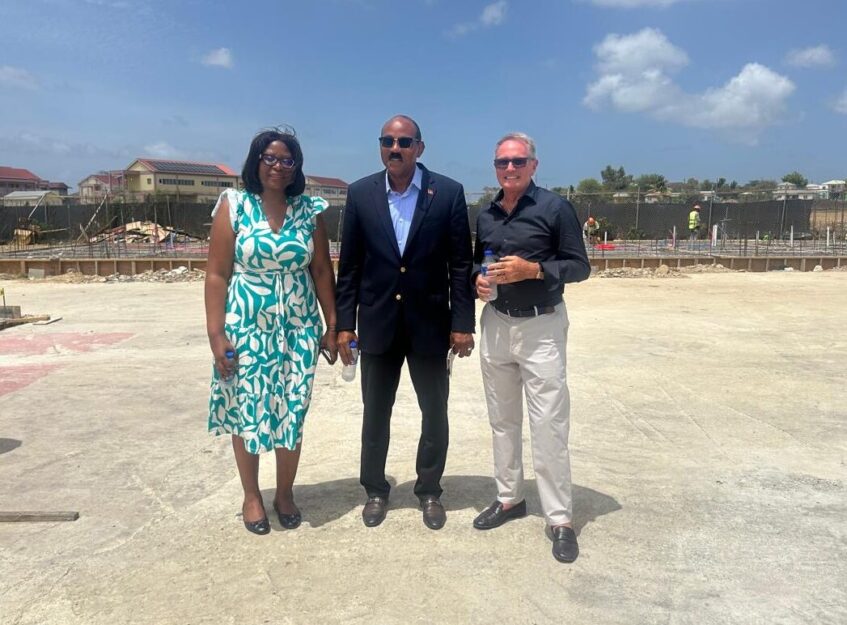
The multi-million-dollar Potters Sports Field Redevelopment Project, a transformative initiative set to reshape recreational and community infrastructure in Potters Village, Antigua and Barbuda, has reached a new milestone as key stakeholders and the project’s lead donor visited the construction site this week.
The project committee rolled out a progress update during the visit of Sir David Harrison, the principal backer of the redevelopment, marking his third on-site inspection since work got underway. Joining the tour was Antigua and Barbuda Prime Minister Gaston Browne, who publicly commended Sir David for his substantial investment that promises to deliver long-term value to both the Potters community and the broader national population.
The visit came just days after another key stakeholder walk-through: High Commissioner Karen-Mae Hill, the visionary who first championed the redevelopment, invited St. George’s Parliamentary Representative Michael Freeland to tour the site, sharing detailed updates on project design and proposed construction timelines.
When complete, the upgraded complex will boast a full suite of world-class recreational amenities, cutting-edge facilities for multiple popular sports. These include top-tier basketball, netball and volleyball hardcourts, a combined cricket and football pitch, a regulation Little League baseball diamond, a dedicated children’s playground, a scenic walking trail, and a half-scale Olympic swimming pool to accommodate local swimming programs and training.
The community-focused project has drawn widespread support from a network of donors across the public and private sectors. A prominent tribute will honor the late Sir Aziz Hadeed, one of the project’s early backers: the combined cricket and football pavilion will be formally named the Aziz Fares Hadeed Pavilion in his memory. Additional financial backing has been provided by Satellite Energy Ltd., Ophir Daniel and Ann Chapman-Daniel, the Department of the Environment, and Bonnie Floyd Ministries. The project has also received critical technical and logistical support from a wide range of national stakeholders, including Governor-General Sir Rodney Williams, the Ministry of Works, the Antigua and Barbuda Board of Education, the Ministry of Sports, APUA, the Port Authority, C.E.A.S Engineering’s Evron Zachariah, Cricket West Indies, the Survey Department, and the National Solid Waste Management Authority.
A core defining feature of the project is its commitment to local economic empowerment: 80 percent of all construction workers hired for the redevelopment are residents of Potters Village. This requirement ensures that the immediate economic benefits of the large-scale investment stay within the community, while also creating opportunities for local workers to build new skills and secure sustained employment.
Project technical leaders confirmed that construction will proceed in staggered phases, with the outdoor hardcourt sports facilities marked as the first major completed component set for handover. Materials for spectator seating stands have already been purchased, with delivery scheduled for the end of July.
For Hill, who grew up in the community, the project is far more than a construction effort—it is a mission to lift up the neighborhood that shaped her. She emphasized that the completed complex will act as a catalyst for multiple public goods, boosting physical activity and public health, supporting mental well-being, strengthening social connection across community groups, creating new development opportunities for young people, and spurring local small business entrepreneurship.
Once fully completed, the redeveloped sports complex will fill a critical gap as a leading venue for local community gatherings, inter-school sports competitions, and national sporting events. Beyond that, it will position Potters Village to bid for future regional and international sporting events, including future editions of the Commonwealth Games, bringing increased visibility and economic activity to the area for years to come.