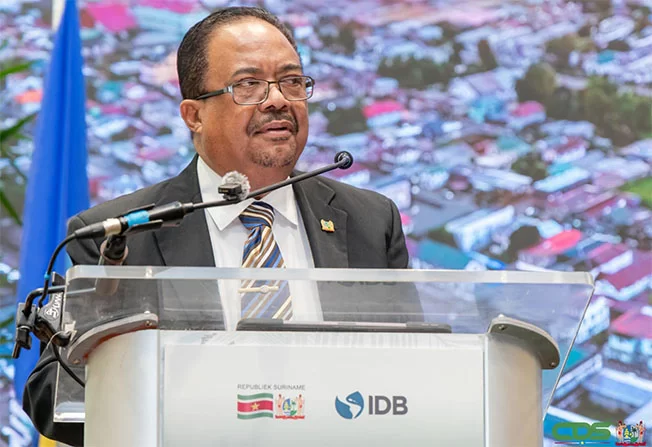
In closing remarks delivered Wednesday at the 2026 National Education Congress held at Paramaribo’s iconic Hotel Torarica, Suriname Vice President Gregory Rusland announced a landmark government initiative to develop a long-term national education framework that will guide the sector’s strategic direction through 2035.
Rusland emphasized that education must be repositioned at the heart of the country’s national development agenda, moving away from the outdated framing of education as an isolated government portfolio. “Education must become the core engine driving our national growth,” the vice president stated, stressing that sustained economic expansion, meaningful poverty reduction, and broad societal progress simply cannot be achieved without a robust, future-ready education system that adapts to evolving global and local needs.
Over the three-day gathering, education researchers, senior policy officials, and civil society representatives gathered to examine pressing systemic challenges facing the nation’s education sector and co-design potential reform pathways. Rusland confirmed that insights and recommendations from the congress will form the foundational base for the long-term national education vision, a framework intended to outlast individual government terms and secure cross-administration continuity for long-term reform.
Looking at near-term priorities through 2029, Rusland outlined six key focus areas: closing persistent learning gaps that have left marginalized students behind, addressing the widespread teacher shortage across the country, boosting professional recognition and motivation for educators, upgrading aging and inadequate school infrastructure, and expanding equitable access to education services for communities in the country’s interior regions.
A further core priority is strengthening alignment between education outcomes and labor market demand. To that end, the vice president highlighted vocational training, technical education, and entrepreneurship skills development as central pillars of the country’s future education strategy. He added that lasting education reform can only succeed if educators are positioned as central leaders in the change process, calling for improved working conditions for teachers, greater educator participation in policy design, and broader societal recognition of the teaching profession.
Rusland also reiterated the government’s commitment to building a far more inclusive education system that guarantees all children equal opportunity to develop their unique talents, regardless of background or geographic location. In his final address, he urged all stakeholders to move beyond rhetorical commitment and paper reports, urging that the congress’s recommendations be translated into tangible policy actions and implementable public programs. “Real change happens when ideas turn into policy, policy turns into programs, programs turn into action, and action turns into measurable results that improve lives,” Rusland said.