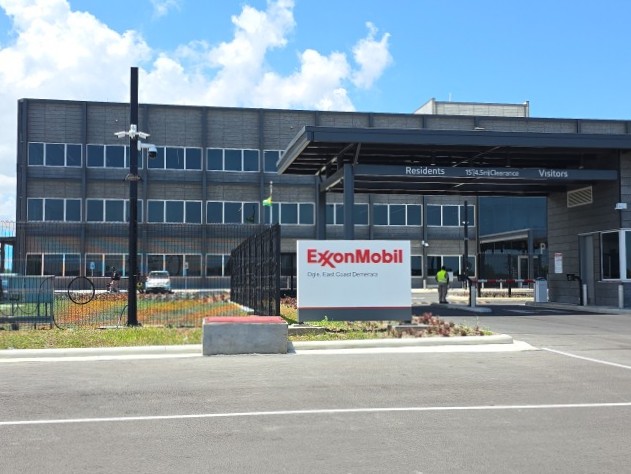
On Tuesday, June 9, 2026, ExxonMobil Guyana announced that it has already set aside more than 489 million U.S. dollars (equivalent to 102.8 billion Guyanese dollars) as its proportional contribution to a national decommissioning fund, which will be used to safely retire offshore oil infrastructure and seal depleted production wells once extraction operations conclude in the Stabroek Block. Negotiations over the formal terms and operational structure of this fund are still ongoing between the energy giant’s local subsidiary, ExxonMobil Guyana Limited, and the government of Guyana, company officials confirmed during a public media briefing.
John Colling, ExxonMobil Guyana’s Vice President and Business Services Manager, told reporters that while no firm deadline has been set for concluding negotiations, discussions between the two parties have progressed smoothly and been marked as “very productive” to date. The allocated sum already appears as an “asset retirement obligation” on the company’s 2025 audited financial statement, which was recently filed with Guyana’s Corporate Registry. The total accumulates proportional contributions from three operating years: 2023, 2024, and 2025.
Colling emphasized that ExxonMobil’s goal is to reach a final agreement that aligns with multiple key priorities. “Ultimately what we’re looking for is a fund that is consistent with the Petroleum Act as well as international best practices, that ultimately provides the financial assurance required by the government of Guyana and is also industry best practice to encourage future investors to continue to do business here in Guyana,” he explained.
The contribution amount reflects ExxonMobil’s 45 percent ownership stake in the Stabroek Block, the prolific offshore oil development that transformed Guyana into one of the world’s newest major oil producers. The remaining shares are held by two other global energy firms: China National Offshore Oil Corporation (CNOOC) holds 25 percent, while Chevron controls the 30 percent stake previously owned by Hess Corporation. Per industry norms, all co-owners will contribute to the decommissioning fund proportional to their ownership shares.
Guyana made history in 2019 when it launched its first ever commercial oil production from the Stabroek Block’s Liza 1 well. Since that first launch, the country’s oil sector has expanded rapidly, drawing billions in foreign investment and reshaping the small South American nation’s economic outlook. Decommissioning planning is a standard regulatory requirement for offshore oil operations, designed to ensure that funds are available to clean up infrastructure and close wells safely at the end of their production lifespans, eliminating future financial and environmental risks for the host government.