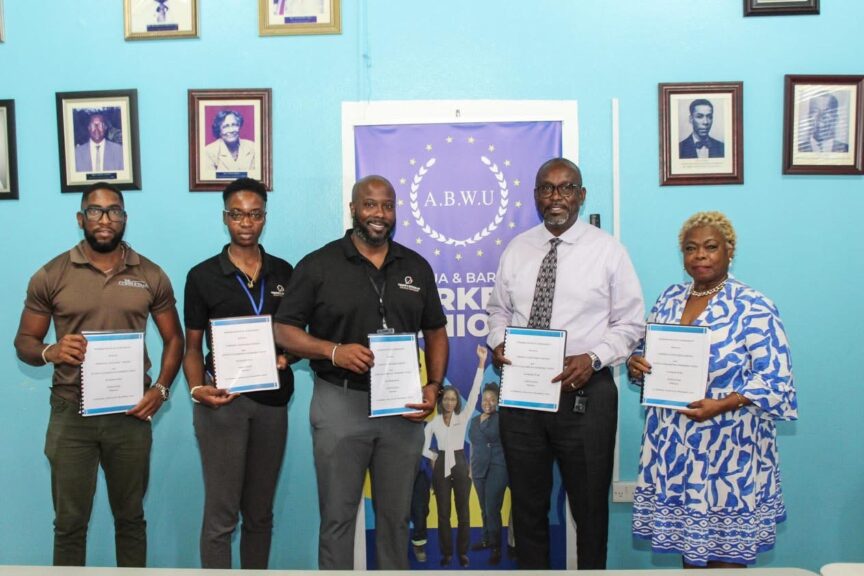
After years of deadlocked negotiations, workers at Vernon G. Edwards Limited are set to receive upgraded benefits and improved working conditions, after the company and the Antigua and Barbuda Workers’ Union (ABWU) finalized the firm’s first-ever Collective Bargaining Agreement (CBA). This milestone deal caps off a years-long negotiation process that only gained momentum in recent months, following the company’s appointment of a fresh management and negotiation leadership team. Hazel Luke, ABWU’s Industrial Relations Consultant, attributed the long-awaited breakthrough to two key factors: the cooperative, solution-focused framework adopted by the new management, and the consistent, active engagement of workers throughout every stage of talks.
“The new management team, headed by Jamil Spencer, showed a real commitment to constructive dialogue and moving negotiations out of the stalled phase they’d been stuck in for years,” Luke explained. “Workers and their elected shop stewards also played an indispensable role, bringing consistent commitment and thoughtful, meaningful input to the table.”
During bargaining discussions, union representatives recognized that Vernon G. Edwards had already implemented significant, proactive salary adjustments for its workforce outside of the formal CBA process. In acknowledgment of these pre-agreement increases, both sides agreed to a structured wage schedule: a one-year wage freeze for 2025, followed by a 2% wage hike in 2026 and a second 2% increase in 2027. The three-year agreement will run from January 1, 2025, through December 31, 2027.
Beyond the structured wage plan, the CBA delivers a suite of tangible improvements to employee benefits that address common worker priorities. These include expanded annual vacation entitlements for all staff, a new policy that allows workers to roll over up to one-third of their unused vacation leave from one calendar year to the next, a 10% discount on freight fees for employees’ personal imported goods, and guaranteed transportation for any employee who works shifts extending past 6:30 p.m.
ABWU General Secretary David Massiah celebrated the successful conclusion of negotiations, underscoring the union’s core mission of nurturing mutually beneficial working partnerships between labor and management. “Our union works to build collaborative, constructive relationships that deliver gains for both workers and employers,” Massiah said. “We firmly believe that strong, transparent industrial relations lay the groundwork for more resilient businesses, more satisfied workforces, and healthier, more productive workplaces for everyone involved.”
Jake Taylor, an industrial relations consultant who participated in the negotiations, also shared his satisfaction with the final outcome, pointing to the company’s demonstrated commitment to collaborative problem-solving. “We’re thrilled to have reached this milestone after so many years of impasse,” Taylor said. “Our goal moving forward is to build a lasting culture of collaboration. Too often, outdated narratives frame management and unions as inherent adversaries, but this deal proves that when both sides come to the table in good faith, we can reach outcomes that serve employees well and support the long-term success of the business.”