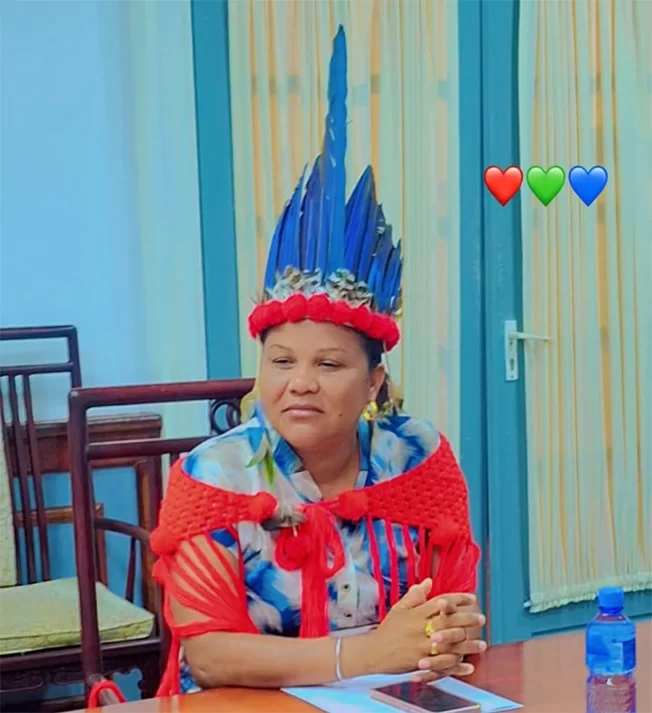
Residents of the small indigenous village of Grankreek, located in Suriname’s Saramacca district, have issued a formal ultimatum to the country’s Ministry of Land and Forest Management (GBB), demanding written clarification on the results of a promised investigation into unauthorized sand excavation activities within and around the community’s traditional territorial lands within 14 days. Village head Angelique Palmtak confirmed that if no substantive official response is received by the deadline, the Grankreek community is prepared to escalate the matter through national legal channels and even pursue international advocacy to defend its territorial and environmental rights.
The ultimatum, delivered in an official letter dated June 8 and addressed to GBB Minister Stanley Soeropawiro and Bronto Somohardjo, chair of the GBB parliamentary commission, comes after months of growing uncertainty and unmet promises from national authorities. The conflict stretches back to a March 5, 2026, official visit by Soeropawiro and Somohardjo to Grankreek, where village leaders and residents first raised a cascade of urgent concerns about ongoing unregulated sand mining operations near the community. Among the grievances presented were the siting of a large sand extraction pit dangerously close to residential areas, repeated violations of existing permit conditions, unaddressed public health and ecosystem risks, the complete lack of prior consultation with the indigenous community, and the absence of a mandatory environmental impact assessment before operations began.
During that March visit, village representatives state that GBB officials publicly committed to completing a full investigation into the allegations within two weeks, with a full written report to be shared directly with the Grankreek community. Three months later, the village has yet to receive any formal written documentation or official policy decision related to the probe. An informal oral update was provided via Saramacca District Commissioner Aniel Ramautar and National Assembly member Jayant Lalbiharie of the NDP party on May 2, during which community representatives were told the GBB investigation had concluded and the full case file had been forwarded to Suriname President Jennifer Simons for review. No written confirmation of this update, or any formal official position on the investigation’s findings, has ever been shared with Grankreek’s governing body.
Palmtak emphasized that the Grankreek community cannot continue to navigate this crisis based on unconfirmed rumors and informal secondhand updates. “Our community deserves clear answers, full transparency, and basic respect for our rights as indigenous residents of this land,” Palmtak stated in an interview following the letter’s delivery. “Our residents live with the daily impacts of these sand excavations on their living environment and personal safety right now.” Without formal communication from the ministry, village leaders cannot properly protect the community’s legal rights or keep residents fully informed of developments, she added.
In addition to the letter sent to GBB, the Grankreek village council has sent a separate formal communication to Minister David Abiamofo of the Ministry of Natural Resources (NH), expressing deep concern over the ministry’s complete silence on prior correspondence about the same sand extraction issue. Village leaders argue that the ministry’s ongoing lack of response is administratively unacceptable, given the severity of the reported environmental damage, the tangible safety threats to the community, and the fact that the excavation permits in question were issued directly by the NH, with direct, life-altering impacts on the indigenous community.
“The constant silence from authorities sends a clear message that our community’s concerns are being ignored,” Palmtak said. “This not only erodes public trust in the national government, but it also amplifies uncertainty and increases the risk of further escalation of this conflict.” The Grankreek village council reaffirmed that transparency, timely communication, and full respect for the territorial and human rights of indigenous communities are non-negotiable foundations of responsible governance and sustainable, equitable decision-making in Suriname.