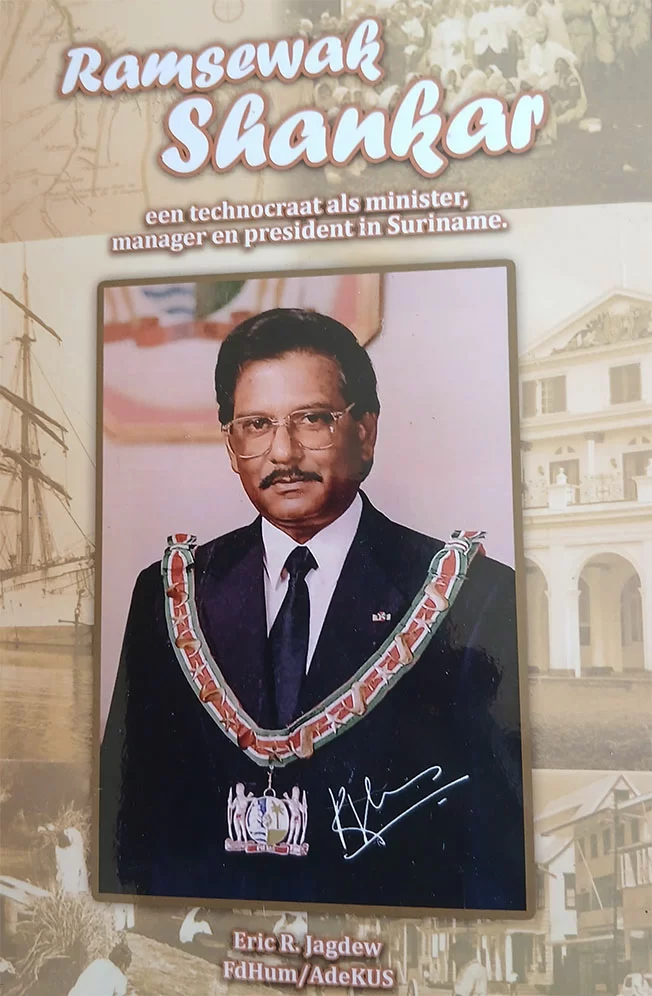
A recently published biography of Ramsewak Shankar, Suriname’s former president, has emerged as a landmark contribution to the documentation of Suriname’s modern national history, written by historian Eric Jagdew. Titled *Ramsewak Shankar: een technocraat als minister, manager en president in Suriname* (Ramsewak Shankar: A Technocrat as Minister, Manager and President in Suriname) and carrying the International Standard Book Number 978-99914-2-032-5, the work does far more than chronicle the public and private life of one of Suriname’s most underrecognized leaders. It also contextualizes Shankar’s policy decisions and leadership within the tangled political and social upheaval that defined 1980s and early 1990s Suriname.
Reviewer Asha Remesan notes that Jagdew has crafted a nuanced, balanced portrait of a leader widely remembered for his unwavering integrity, humble demeanor, and deep sense of public duty. What makes this biography particularly vital, Remesan argues, is its focus on a historical period and a head of state that have long received insufficient acknowledgment in official and popular Surinamese national history. Shankar assumed office at an exceptionally fragile moment for Suriname’s young democracy, stepping in to steer a nation still recovering from years of crippling political instability. Unlike many leaders motivated by personal ambition or the pursuit of public fame, Shankar’s tenure was rooted in a profound sense of accountability to the Surinamese people and the future of his country.
Jagdew avoids the common biographical pitfall of framing his subject as an infallible icon. Instead, he presents Shankar as a fallible, ordinary person forced to make high-stakes choices under extraordinarily difficult circumstances – a choice that only adds to the book’s credibility, according to the review. Drawing on years of extensive original research, the text offers readers rare, valuable insight into the root causes and context of many defining events in modern Surinamese history.
Perhaps the biography’s greatest strength, Remesan observes, is its depiction of Shankar’s enduring humility despite holding the nation’s highest office. In an era where political leaders are often judged on their public image and self-promotion, Shankar’s life story serves as a timely reminder that solid governance, integrity, and selfless public service remain irreplaceable leadership qualities.
This publication deserves a wide readership, Remesan concludes. It stands both as a fitting tribute to Ramsewak Shankar’s legacy and a testament to Eric Jagdew’s meticulous work to preserve a critical, long-overlooked chapter of Suriname’s national history. Ultimately, it is a valuable and much-needed volume that advances a more balanced, fair assessment of both Shankar the man and his enduring impact on Suriname.