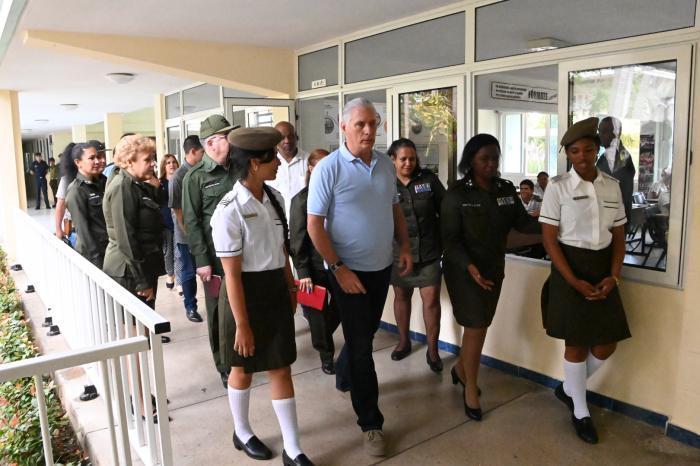
On Thursday, June 5, 2026, Cuban President and First Secretary of the Central Committee of the Communist Party Miguel Díaz-Canel Bermúdez undertook an official visit to the unique Hermanos Martínez Tamayo Vocational Pre-University Institute, operated by the country’s Ministry of the Interior (Minint) in Havana’s Playa municipality. He was joined on the visit by Lázaro Alberto Álvarez Casas, Minint Minister, Army Corps General and member of the Communist Party Political Bureau.
The visit came at the direct request of a student from the institute, who raised the invitation during a previous public event where the two leaders crossed paths. During an open, heartfelt exchange with students, graduates, faculty and institutional leadership, Díaz-Canel offered high praise for the institute’s educational framework, labeling it a “distinct, innovative, and demanding educational model” that aligns with the revolutionary vision first laid out by Fidel Castro during the development of the Battle of Ideas initiative.
Díaz-Canel told attendees he was particularly impressed by the institute’s ability to maintain its high standards of operation for decades, including through the ongoing challenging period that has strained educational systems across Cuba. He noted that the Ministry of the Interior, already widely recognized by the Cuban people for its critical public service, has extra reason to take pride in hosting such an exceptional educational institution.
Commenting on the institute’s well-maintained, orderly and welcoming campus, the president emphasized that holistic education extends far beyond textbook curriculum. Physical environments that nurture and inspire the spirit, he explained, are a core component of meaningful learning that prepares young people for public life.
Throughout the conversation, which preceded a guided tour of the institute’s classrooms and research laboratories, Díaz-Canel stressed the ongoing importance of fostering critical thinking, revolutionary commitment, and well-rounded personal development to prepare young Cubans to contribute to the country’s socialist construction project as engaged, responsible citizens. After hearing personal accounts from students, professional insights from graduates, and reflections from teaching staff, the president noted that the visit offered a critical morale boost amid the country’s current complex context, which has been shaped by persistent external aggression from the United States. “Talking with you, seeing your willingness, your commitment, your training, and the way you express yourselves, also reaffirms the feelings of appreciation one has for this institution. This strengthens us greatly and also gives us a lot of energy,” he stressed.
Díaz-Canel extended an invitation to students to join the Community Youth Network, a new grassroots initiative that organizes Cuban youth for neighborhood-focused public service work. He also urged attendees to prioritize rigorous study, deep exploration of history and science, and independent inquiry, explaining that these practices build the knowledge and critical perspective needed to make thoughtful, informed decisions that benefit the nation. The conversation also included open discussion of the severe economic and social strain placed on Cuba by the United States’ long-running suffocating embargo policy.
In comments to reporters following the visit, institute director Colonel Vivian Sabuquet Larrondo outlined the institution’s 22-year legacy of public service. As the only pre-university of its kind in Cuba, the school holds a unique mission: training the next generation of Minint officers and personnel, while also preparing graduates who choose to pursue civilian higher education. To date, more than 4,000 young people have graduated from the program, many of whom now serve in the Ministry of the Interior.
Sabuquet Larrondo explained that the institute delivers a fully holistic education that integrates patriotic formation, military preparation, physical education, cultural programming, athletic opportunities, and cutting-edge instruction in technology and scientific development. Students enter the institution between the ages of 14 and 15, graduate at 17, and learn from a faculty of highly experienced educators who bring strong professional expertise and a deep commitment to core revolutionary values. Beyond academics, the school instills foundational life skills including disciplined coexistence, strong work ethic, solidarity, humanism, and patriotism, with ongoing support from students’ family members. “I think the most important thing is the contribution we have made, not only to the Ministry of the Interior, but also to society,” Sabuquet Larrondo noted.