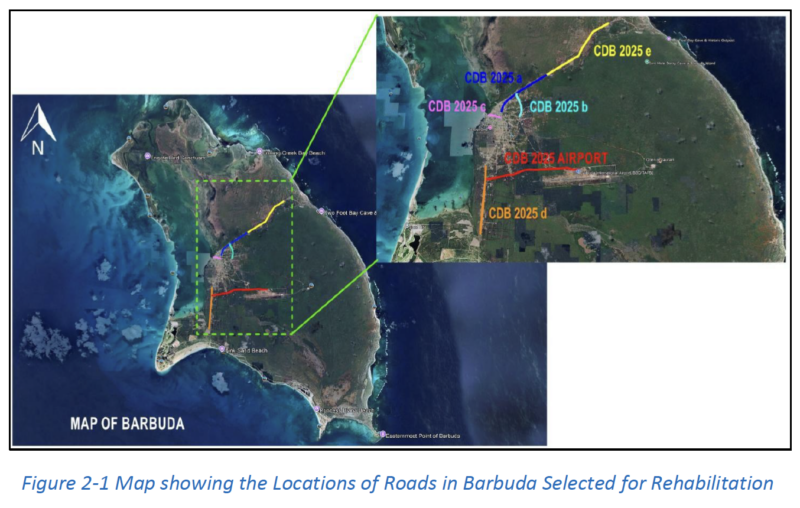
Antigua and Barbuda’s government has launched a public consultation period for a transformative 12.6-kilometer road rehabilitation initiative on the island of Barbuda, releasing all required planning, engineering and environmental assessments to invite input from residents and industry stakeholders ahead of construction. The project, which forms a core part of the national post-Hurricane Irma recovery program, is backed by financing from the Caribbean Development Bank and falls under the country’s Hurricane Irma Rehabilitation and Reconstruction Loan framework.
The Ministry of Housing and Works has made a full suite of planning documents available for public review, including a comprehensive Environmental and Social Management Plan, an initial engineering inception report, a corridor characterization and priority ranking analysis, and a groundbreaking social and gender sensitisation study. Upgrades are targeted at six high-priority road corridors across the island, spanning key routes that serve critical public and economic infrastructure: sections of River Road, the Codrington Wharf access zone, routes connecting to Sir McChesney George Secondary School, the Green Barbuda Solar Hybrid Power Station, and Burton-Nibbs International Airport. These routes were selected specifically for their outsize role in supporting daily transportation, emergency response operations, community access to services, and long-term economic growth for the island.
Environmental assessors have categorized the project as a Category B development, meaning all potential negative environmental and social impacts are predicted to be geographically limited and fully manageable through targeted mitigation strategies. The initial environmental review identified a set of key risks that will require continuous monitoring throughout the construction phase, including potential contamination of local groundwater reserves, excess water consumption during works, risks to community health and safety, occupational hazards for construction crews, and potential harm to sensitive marine and coastal ecosystems surrounding the protected Codrington Lagoon. To address these concerns, project planners have pre-approved a series of protective measures: targeted erosion control infrastructure, expanded and upgraded drainage networks, ongoing third-party environmental monitoring, formalized waste management protocols, and specific protocols to protect any unknown archaeological or cultural resources that may be uncovered during excavation.
A key priority integrated into the project design is a comprehensive set of climate resilience upgrades, developed to address Barbuda’s long-standing geographic vulnerabilities. The proposed road design uses reinforced concrete pavement engineered to withstand severe flooding, alongside larger, upgraded culverts, a fully redesigned island-wide drainage system, and pre-construction geophysical surveys to map and fill underground voids before heavy building works begin. These changes are designed to resolve persistent challenges tied to Barbuda’s flat terrain, naturally poor drainage, and ongoing high risk of storm-related flooding as climate change increases the frequency of extreme weather events in the Caribbean.
The corridor characterization report positions the road upgrades as a foundational piece of Barbuda’s broader long-term development strategy. The document notes that the island is poised to see a wave of new private and public investment in coming years, including expanded tourism infrastructure, expansion of Burton-Nibbs International Airport, construction of a new combined cargo and tourism port, new residential housing developments, and additional renewable energy projects. Improved, more resilient road networks will be critical to supporting this growth while also making daily travel easier for residents and cutting response times for emergency services during crises.
The accompanying gender sensitisation study also highlights a long-standing equity gap in Antigua and Barbuda’s construction sector: official employment data shows just 138 women working in construction across the country, compared to more than 3,400 men. The study’s findings will be used to help government agencies and private contractors implement policies that advance gender equality and social inclusion across all future infrastructure projects on the island.
Once construction gets underway, the full build-out is expected to take between 18 and 24 months to complete. Following the conclusion of construction, a mandatory 12-month monitoring period will be held to assess the performance of the new drainage systems and resolve any remaining unforeseen environmental impacts. Government officials have emphasized that public input is a core part of the project development process, and are encouraging all residents and interested stakeholders to review the full set of released documents and submit comments, concerns, or recommendations to help refine the project’s final design and implementation plan before works break ground. All full documents are available for review via the official website of Antigua and Barbuda’s Department of Environment.