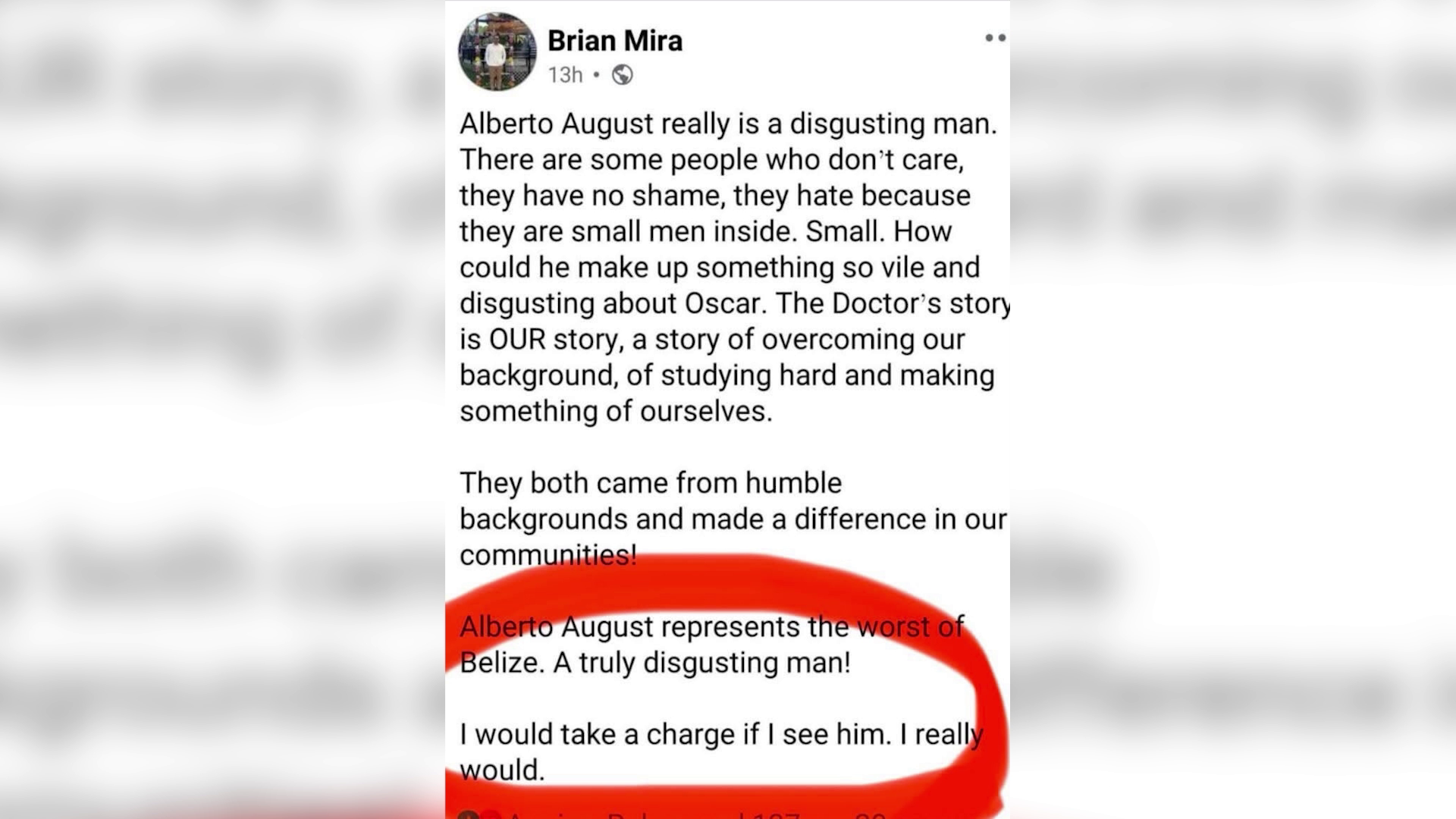
A 2026 case centered on a satirical social media post in Belize has sparked intense public and legal debate over the boundaries of free expression, consistent application of the law, and potential political interference in criminal justice.
The controversy began when former United Democratic Party (UDP) Chairman Alberto August posted an ironic commentary on Facebook mocking government minister Oscar Mira, referencing past comments Mira made regarding a widely discussed incident in Belmopan. August did not present the satirical content as a direct, quoted statement from the minister, but authorities nonetheless moved to criminally charge August under Belize’s Cybercrime Act following the post. In an unusually aggressive law enforcement action, six officers detained August at his home, holding him in custody for more than 24 hours before formal charges were filed.
Prominent Belizean attorney Michael Peyrefitte, who has emerged as a leading critic of the government’s handling of the case, argues that the prosecution represents a clear overreach of state power. Peyrefitte emphasizes that even if the minister or his allies found the post offensive, the dispute should have been handled exclusively through civil litigation—most likely a defamation lawsuit—rather than being escalated to a criminal matter. “This never belonged in criminal court,” Peyrefitte stated in comments to local media, pushing back against the decision to pursue criminal charges rather than a civil remedy. He went on to detail the heavy-handed nature of the arrest, noting that law enforcement carried out the detention with what he described as “military precision,” intimidating August’s family in the process.
Beyond the question of whether a satirical post merits criminal charges, Peyrefitte has drawn attention to a stark double standard in how Belizean authorities have approached similar online content, raising serious accusations of selective enforcement. He points to a separate social media post from Brian Mira, Minister Oscar Mira’s brother, that contained a thinly veiled threat of violence against August. In the post, Brian Mira wrote that he would “catch a charge” if he encountered August, a statement widely interpreted as a warning that he would commit a criminal act against the former UDP chairman. While the post was deleted hours after it was published, it remains public record—yet no law enforcement action has been taken against Brian Mira, and he has never been detained, questioned, or charged in connection with the threat.
August has confirmed that he takes the threat seriously and has implemented additional safety measures to protect himself and his family from potential harm. Peyrefitte argues that the contrasting outcomes of the two incidents expose a deeply troubling imbalance in Belize’s justice system: a satirical political post leads to immediate arrest and criminal prosecution, while an explicit threat of violence against an opposition figure draws no response from authorities at all. “If we locked up every person who says something provocative or offensive on social media, every jail in the country would be overflowing,” Peyrefitte noted, pointing out that many Belizeans have posted far more extreme content online without facing any legal consequences.
The case has reignited long-simmering concerns about the use of Belize’s Cybercrime Act to target political opposition, with critics arguing that the law is being weaponized to silence dissenting voices rather than address actual cybercrime. Questions about judicial independence and equal application of the law continue to circulate as the criminal case against August moves forward, with observers across Belize watching closely to see how the controversy will impact future discussions of free speech and political fairness in the country.