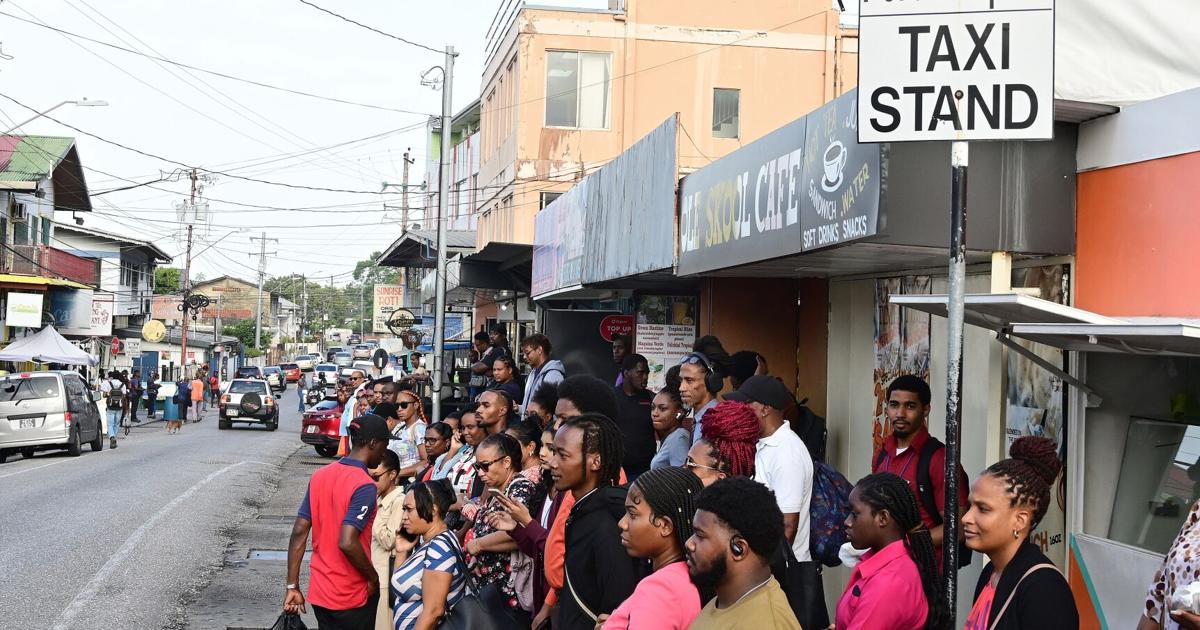
Thousands of daily commuters across Trinidad and Tobago faced widespread travel chaos and massive disruption on Monday, when 5,000 of the nation’s maxi-taxi operators launched the first day of what they labeled a “rest and reflection” industrial action, leaving many stranded for hours and forcing others to pay exorbitant premium prices for alternative transport. The disruption impacted commuters across major population corridors, including the entire East-West corridor covering Curepe and Arima, as well as the central and southern hubs of Chaguanas and San Fernando, disrupting routines for both workers heading to jobs and students traveling to classes.
For many regular maxi-taxi users, the day began long before their usual schedule. Multiple workers told local outlet Trinidad Express that they left their homes 1 to 2 hours earlier than normal in a bid to beat the expected disruption, yet many still arrived hours late to their workplaces — and a portion of affected commuters never made it in at all. At high-traffic transit nodes including Curepe Junction and the Tunapuna area adjacent to the local market, crowds of stranded passengers lined the entire westbound shoulder of the Priority Bus Route (PBR), waiting hours for any available public transport that already filled to capacity by the time it arrived. Desperate for options, many commuters reached out to friends and family with private vehicles, begging for emergency lifts to their destinations.
Interviews with affected commuters painted a picture of both logistical chaos and unexpected financial strain. Many passengers reported waiting for available transport as early as 5 a.m., with no luck securing a maxi-taxi. Cassandra Armstrong, a regular maxi user who commutes to her job in Macoya from Tunapuna, told reporters that by 8 a.m. she was still stuck along the PBR, relying on a last-minute ride from a co-worker to get to her shift. One male commuter told Express he walked all the way from Macoya to the Tunapuna Market transit hub in search of an available maxi, only to wait nearly two hours with no luck before calling his employer to say he could not come to work.
At Curepe Junction, a mother holding her young daughter’s hand described feeling abandoned by the striking operators, watching full public transit buses and empty maxi-taxis pass her by without stopping. “They doh care about people children at all. Look at what they putting me through,” she told reporters. Another commuter, who asked to remain anonymous, said she planned ahead for the strike by prepping to use a ride-sharing app Sunday night, but found she was far from alone in that idea — by yesterday morning, there were no ride-share drivers available anywhere in her area. “Whole morning. Nothing at all you know…nothing,” she said.
Empty maxi-taxis owned by striking operators were spotted speeding through major transit hubs, a sight that frustrated waiting passengers. “Look at them. They just torturing people now,” one waiting woman said. With the shortage of formal transport, informal independent operators stepped in to capitalize on the crisis, charging inflated fares far above standard maxi-taxi rates. One driver who normally runs the Curepe to Maracas Valley, St Joseph route told reporters he was charging passengers $20 per person just to travel to Tunapuna, with higher rates for destinations further along the corridor. “It is a hustle out here. Money hadda make,” he said.
Photographs from the day captured the scale of the disruption: at Port of Spain’s City Gate Transport Hub, a usually busy lot that normally holds dozens of waiting maxi-taxis sat nearly empty by 10:23 a.m., while students sat on their own lunch kits on the hub’s sidewalk, waiting hours for any available ride. Passengers who did manage to squeeze into overcrowded public transit buses were visibly weary, with one onlooker noting, “When last you see bus full so.” Multiple commuters highlighted that beyond the inconvenience of missed work and school, the strike imposed an immediate unplanned financial burden, as alternative ride-sharing and private taxi options cost far more than the affordable maxi-taxi fares they rely on for daily travel. The action marks the first day of a three-day work stoppage by maxi-taxi operators across the nation.