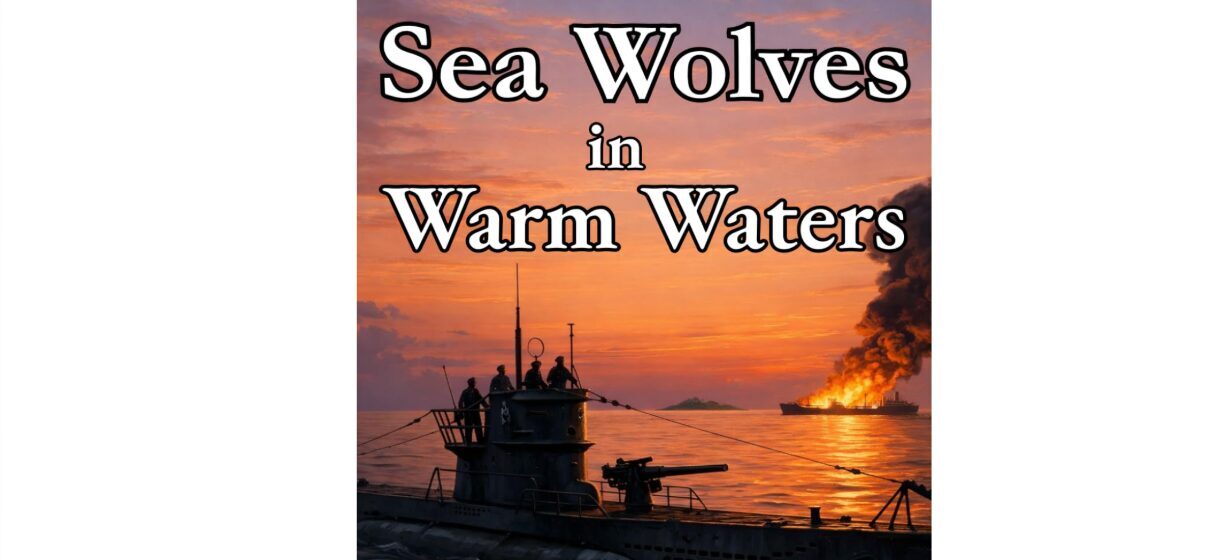
For most students and enthusiasts of World War Two naval history, the Caribbean theatre is rarely given the attention it deserves. Popular and even academic narratives often fixate on better-known battlegrounds, from the high-stakes Atlantic convoy crossings to the frigid Arctic supply routes, framing the sun-drenched Caribbean archipelago as a tranquil backdrop far removed from the chaos of global conflict. That widespread neglect is exactly what author and Caribbean scholar Clement Richards sets out to correct with his new release, *Sea Wolves in Warm Waters: The U-boat Battle in the Caribbean*, published in May 2026. A new review from military historian Dr. James Bosbotinis, originally featured in The Naval Review, offers a balanced deep dive into this groundbreaking work of historiography, which the book’s author has since responded to with contextual clarifications.
Drawing on hundreds of declassified multinational archival sources – ranging from official military war diaries to cabinet-level government policy documents – Richards repositions the Caribbean as a strategically critical linchpin of the Allied war effort, rather than a peripheral afterthought. During Operation NEULAND, Germany’s 1942 offensive in the region, Nazi U-boats targeted the Caribbean’s core economic assets: the massive oil refineries across Aruba, Curaçao, and Trinidad, plus key shipping lanes that carried vital supplies of oil and bauxite to feed Allied industrial production. By cross-referencing Grand Admiral Karl Dönitz’s personal diaries with the individual operational logs of deployed U-boats, Richards builds a convincing case that Operation NEULAND was not a scattered string of opportunistic raids, but a coordinated, well-planned strike aimed at crippling a core Allied supply artery.
The book’s multi-perspective framework draws on four distinct source bases: German military records, British high command policy papers, U.S. intelligence summaries, and local Caribbean community and government archives. This approach allows Richards to clearly trace how Allied defenses in the region evolved over the course of the campaign, from the initial uncoordinated response to the gradual rollout of formal convoy systems, expanded aerial patrol coverage, and growing anti-submarine warfare capacity that steadily eroded U-boat effectiveness by the mid-war period.
One of the book’s greatest strengths is its commitment to centering the human cost of the conflict, rather than only detailing troop movements and strategic planning. Richards shines a light on the experiences of merchant seamen who suddenly found their routine shipping routes transformed into killing fields, where torpedo strikes left ships burning and leaking oil across once-calm waters. He also explores how the war abruptly shattered the relative peace of Caribbean island communities, which had long viewed the global conflict as a distant European affair. Beyond the immediate violence, Richards details how the massive military infrastructure built by the Allies during the war permanently reshaped Caribbean islands physically and economically, laying the groundwork for the modern commercial tourism industry and accelerating the push for decolonization in the post-war era.
For all its contributions to the field, Bosbotinis notes the work is not without its limitations. A notable methodological imbalance emerges from the uneven availability of source material: while German, British and American military operations are reconstructed through detailed, complete institutional records, the experiences of local Caribbean populations are drawn from far more fragmented sources, including oral histories and scattered social accounts. This leads to a narrative that often frames Caribbean communities primarily through stories of suffering, rather than highlighting instances of local agency and active participation in the war effort. Additionally, Bosbotinis argues that the text devotes disproportionate space to the opening phase of Operation NEULAND in 1942, leading to repetitive coverage of the initial German offensive and the region’s first response, while the period after 1943 – when Allies had solidified their defensive posture – is covered far too briefly. This overemphasis on the initial “crisis” phase leaves the long-term impacts of wartime mobilization on daily Caribbean life underexplored. Finally, while Anglophone Caribbean communities receive extensive coverage, the Dutch ABC Islands and Vichy-controlled French Antilles are given only limited treatment, and the author’s choice to use summary source notes rather than full detailed citations will likely frustrate academic researchers hoping to verify specific claims or follow up on obscure local incidents.
Despite these shortcomings, Bosbotinis concludes that *Sea Wolves in Warm Waters* is an indispensable addition to both World War Two maritime history and Caribbean historiography. It builds on the foundational work of earlier scholars like Kelshall and André, while expanding public and academic understanding of how global war touched even the most seemingly remote tropical communities. Even with its structural and geographic gaps, the book successfully challenges the persistent myth of the Caribbean as a passive, peripheral paradise during the war, reminding readers of the strategic importance of the theatre and the enduring legacy of struggle and sacrifice that lies beneath its popular image as a tranquil tourist destination.
Following the publication of the review, Richards released a formal response clarifying two key criticisms raised by Bosbotinis. Addressing the claim that the book overemphasizes Caribbean suffering at the expense of local agency, Richards noted that during the war the Caribbean was almost entirely controlled by colonial powers, leaving local populations with very little scope for autonomous political or military action. As colonial subjects, most Caribbean communities experienced the war as the recipients of Allied policy rather than independent actors, and the emergence of distinct Caribbean political agency only came in the post-independence era after the war ended. That historical context necessarily shaped the narrative structure of the book.
On the topic of limited coverage of French and Dutch Caribbean territories, Richards explained that access to local archival material presented significant practical barriers. Most French Caribbean territories were controlled by Vichy France for much of the war, and language barriers combined with restricted access to local French archives made deep research difficult. Dissident activity from French Caribbean territories connected to the Free French movement is covered in a dedicated chapter of the current book, and Richards plans to explore this topic in full in a future work, given Dominica’s central role in those events. Similar access issues impacted research on Dutch islands, with most available material coming from British and other English-language sources, limiting the depth of local Dutch perspectives that could be incorporated. Richards emphasized that he did not aim to excuse the gaps identified in the review, only to explain the practical contextual constraints that shaped the book’s research and writing.