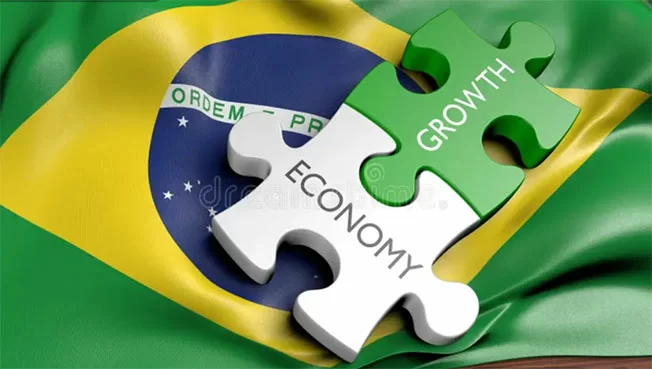
South America’s largest economy Brazil is on the cusp of a major economic milestone, with latest projections from the International Monetary Fund (IMF) indicating the country is set to reclaim its position among the world’s 10 largest national economies by the end of 2026.
The forecast, compiled and validated by independent economic research institutions using IMF data, shows Brazil is on track to secure the 10th spot in the global GDP ranking this year, outpacing economies like Canada to return to the top tier of global economic rankings. This optimistic projection comes on the heels of stronger-than-expected first-quarter growth performance for 2026. Official data shows Brazil’s economy expanded by 1.4% quarter-on-quarter between January and March, placing it among the fastest-growing large economies globally for the period. The growth momentum was driven by three key pillars: robust expansion in the service sector, rising business investment, and resilient domestic consumer demand that has held up despite broader global headwinds.
Per IMF projections, Brazil’s total nominal GDP is expected to hit approximately $2.64 trillion USD in 2026. This output will place the country just behind Russia in the global ranking, and ahead of a number of other major advanced and emerging economies. Economic analysts note that the GDP gap between Brazil and Russia is relatively narrow, meaning continued consistent growth could push Brazil even higher up the global ranking in coming years.
In its latest regional economic assessment, the IMF emphasized that Brazil’s economy has shown remarkable resilience in the face of multiple global challenges, including ongoing geopolitical tensions, elevated global energy prices, and widespread uncertainty across international commodity and financial markets. After a moderate growth slowdown in 2025, recent leading economic indicators point to a broad-based recovery across multiple sectors. The IMF projects Brazil’s growth will gradually strengthen over the medium term, stabilizing at around 2.5% annual growth in the coming years.
Despite the positive outlook, the country still faces notable downside risks and structural challenges. Inflation is currently under upward pressure driven by rising global oil prices, which have been pushed higher by ongoing geopolitical tensions in the Middle East. The federal government is also working to shore up public finances, implementing new spending restrictions to keep national debt levels manageable. Additionally, the labor market has shown mixed signals, with new job creation falling short of economists’ earlier projections.
For neighboring Suriname, Brazil’s projected economic resurgence carries particular strategic and economic significance. Brazil is already South America’s largest economy, and has emerged as an increasingly critical trade partner and strategic neighbor for Suriname in recent years. A faster-growing Brazilian economy is expected to unlock new cross-border collaboration opportunities across trade, agriculture, infrastructure development, energy, and foreign direct investment for Suriname.
Against the backdrop of deepening bilateral ties between the governments of Paramaribo and Brasília, Brazil’s upward economic trajectory is being closely monitored across northern South America. A stronger, more dynamic Brazilian economy is expected to generate broader economic momentum across the entire northern region of South America, with Suriname positioned to directly benefit from this regional growth impulse.