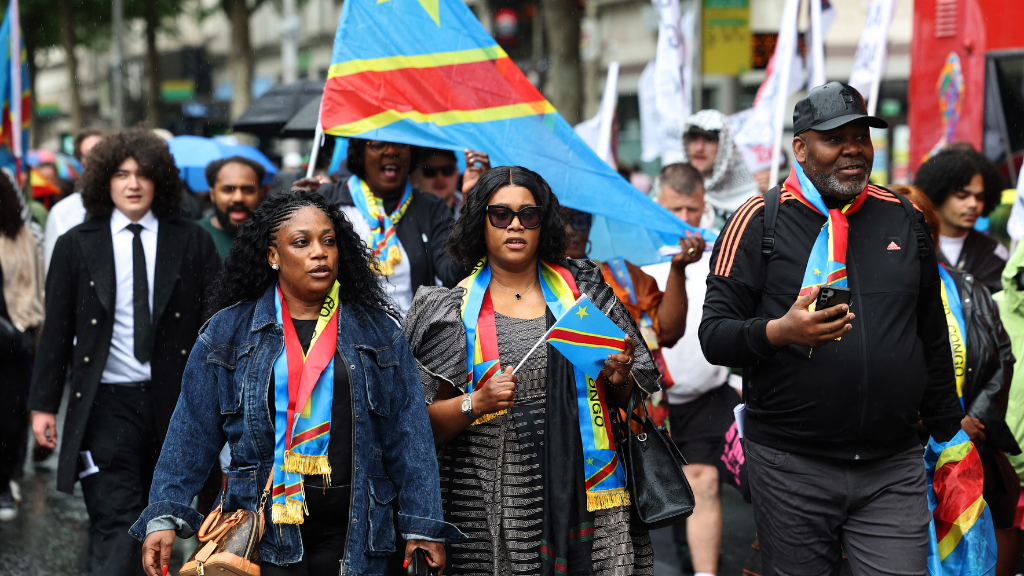
DUBLIN, Ireland — Hundreds of demonstrators gathered in Ireland’s capital Saturday, united in a call for accountability over the death of 35-year-old Yves Sakila, a Congolese man who had built his life in Ireland since 2004, after he died while being restrained by private security personnel earlier this month. Protesters have drawn a stark parallel between Sakila’s death and the 2020 murder of George Floyd at the hands of U.S. police, a killing that ignited the global Black Lives Matter movement and brought worldwide attention to systemic anti-Black violence.
The fatal incident unfolded on May 15 on one of central Dublin’s busiest shopping streets, outside a popular department store. Viral video footage shared widely across social media platforms captured the sequence of events: security workers pinned Sakila to the ground, holding him in that position for nearly five full minutes. Shortly after the restraint, Sakila lost consciousness, and he was pronounced dead after being rushed to a local hospital.
Irish law enforcement has launched an official inquiry into all circumstances surrounding the restraint and subsequent death, but as of Saturday’s demonstration, no findings have been made public, and no charges have been filed against any of the security personnel involved. A post-mortem examination carried out by the state’s chief pathologist has been completed, though the official results remain under wraps pending further investigation.
Approximately 100 attendees turned out for the peaceful demonstration, where speakers highlighted growing community concerns over excessive force, inadequate training for private security staff, and systemic racial inequity in Ireland. “We need justice for Yves Sakila. We need a proper investigation into his death,” Eoghan O Ceannabhain, a Dublin-based musician and protester, told reporters. He went on to note that the incident raises urgent questions about the quality and anti-bias training provided to private security operatives working in public spaces.
The killing has resonated deeply across Ireland’s Black and African communities, especially among the country’s Congolese diaspora, which has long highlighted unaddressed issues of racial profiling and discrimination. “We are standing for the community to ask for justice,” Ono Tambura, a 60-year-old Congolese woman who has resided in Ireland for years, said on the protest lines.
Beyond calls for a full investigation into Sakila’s death, organizers have laid out a clear set of demands for Irish authorities. They are calling for an independent, fully transparent probe that includes a full review of all existing security camera footage and witness testimony. Demonstrators are also pushing for the immediate public release of forensic post-mortem results, and full legal accountability for any individual found to have acted unlawfully in the incident. On a systemic level, campaigners are urging the Irish national government to finally address longstanding complaints of racial profiling and institutional discrimination raised repeatedly by members of racial minority communities across the country.