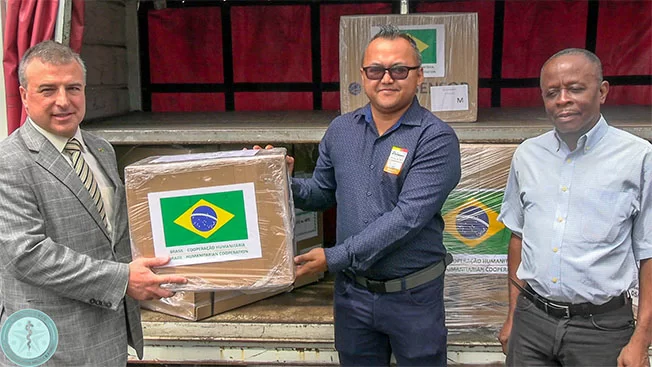
Suriname’s Bureau for Public Health (BOG) has received a substantial donation of life-saving health commodities from the Brazilian government, aimed at strengthening the country’s national public health and immunization infrastructure. The formal handover of the donation took place on Wednesday, with Brazilian Ambassador Felipe Costi Santarosa presenting the supplies to BOG representatives.
The donation package includes 100,000 doses of pneumococcal conjugate vaccine (PCV), 1,500 rapid COVID-19 tests, and 200 doses of tafenoquine, a first-line medication used for malaria treatment. These supplies were specifically requested by Suriname’s Ministry of Health to reinforce ongoing national immunization initiatives, according to Richard Kartomo, manager of BOG’s National Immunization Program (NIP), who accepted the donation on NIP’s behalf.
Kartomo explained that the additional vaccines will help the country expand coverage of its routine vaccination programs, bringing Suriname closer to meeting its key national public health targets. All donated supplies have already been safely stored at BOG facilities, clearing the way for the immediate rollout of targeted immunization activities. The upcoming campaign will prioritize vaccinating children under five years old to protect them against life-threatening pneumococcal infections, a leading cause of child mortality in many low- and middle-income countries.
Notably, frontline health workers involved in delivering the program have already completed specialized training over recent months, meaning all preparations for the campaign are finalized. With the arrival of the donated vaccines, the program can launch without delay.
This donation is part of the deepening bilateral public health and cooperation partnership between Suriname and Brazil. Over the past several years, the two nations have steadily expanded collaboration in the areas of public health capacity building and infectious disease control, with this contribution marking another milestone in their shared commitment to improving regional health outcomes.