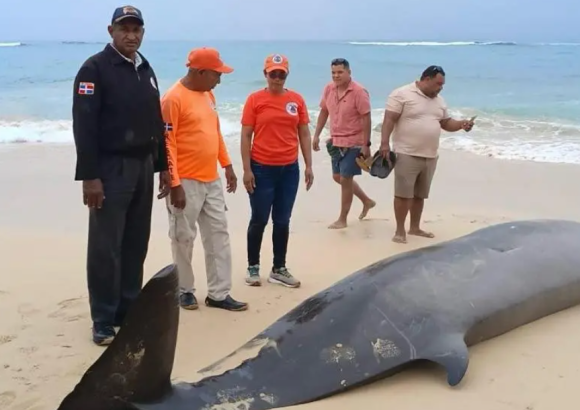
A rare member of the Mesoplodon genus, a little-seen group of deep-dwelling beaked whales, has been found dead on the sands of Playa Grande, located in the Dominican Republic’s María Trinidad Sánchez Province. The unusual stranding has caught the attention of both local coastal communities and regional environmental regulators, as sightings of this elusive cetacean are extremely uncommon in nearshore waters of the area.
Mesoplodon whales fall under the beaked whale group, part of the broader Ziphiidae cetacean family. Unlike many whale species that frequent continental shelf waters or coastal migration routes, these marine mammals are specially adapted to life in remote, open-ocean deep waters, thousands of meters below the surface. Their biology allows them to spend extended periods foraging at extreme depths, only breaking the surface for short, infrequent intervals to breathe. This deep-water lifestyle makes them one of the least observed large mammal groups on Earth, even though researchers currently recognize roughly 14 distinct Mesoplodon species, and the Ziphiidae family counts among the most widely distributed and numerically abundant whale groups in global oceans.
Local environmental authorities confirmed that the stranding of this individual near Río San Juan’s coastline is an out-of-the-ordinary event. Mesoplodon whales almost never venture into shallow coastal waters unless disoriented, injured, or ill, so the presence of a deceased specimen on a popular local beach has raised questions among researchers and officials. At present, environmental teams are conducting a full investigation to pinpoint the exact cause of the whale’s death, and to determine what factors may have driven the animal to leave its preferred deep-water habitat and end up washed ashore.