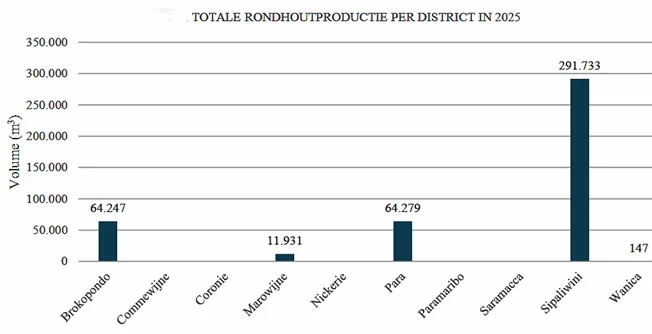
Fresh data released by Suriname’s Foundation for Forest Management and Forest Control (SBB) shows that the country’s total roundwood output edged slightly lower in 2025, marking a modest shift in the nation’s key forestry sector performance. Per the latest official forestry statistics, total production reached 432,337 cubic meters of roundwood equivalent this past year, down from 435,942 cubic meters recorded in 2024.
Geographically, production remains heavily concentrated across the country’s districts, with Sipaliwini standing out as the undisputed core production region. The district alone contributed 291,733 cubic meters of roundwood in 2025, accounting for more than two-thirds of Suriname’s total national output. Following Sipaliwini are Para with 64,279 cubic meters and Brokopondo with 64,247 cubic meters, making these two districts the secondary production hubs. By contrast, Wanica registered just 147 cubic meters of production for the year, while multiple other districts recorded barely any or no commercial roundwood output at all.
When broken down by product type, industrial roundwood — particularly sawlogs and peeling logs — makes up the overwhelming majority of total production. This segment accounted for 430,331 cubic meters of the 2025 total, with smaller volumes of other wood products including utility poles, shingles and sawn timber making up the remaining output.
Production is also heavily centered on concession areas, which generated more than 362,905 cubic meters of roundwood in 2025. Community forests contributed an additional 42,614 cubic meters, with smaller volumes coming from areas covered by general logging permits, LBB reserves and incidental logging permits.
A monthly breakdown of production reveals clear seasonal variations across the year. The highest monthly output was recorded in October, at 52,270 cubic meters, followed closely by November with 51,912 cubic meters. July saw the lowest production level of any month in 2025, with just 20,093 cubic meters harvested.
Among commercial wood species, basralokus retained its position as the most harvested commodity in 2025, with total output reaching 123,962 cubic meters. Other leading commercial species include gronfolo at 69,535 cubic meters, kopi at 32,659 cubic meters, bruinhart at 27,915 cubic meters and wana at 26,294 cubic meters.
On the export side, Asia continues to dominate as the primary destination for Surinamese timber. Approximately 92 percent of total Surinamese wood exports are shipped to Asian markets, with China, India, Singapore and Vietnam ranking as the largest buyers.
SBB officials note that the updated statistics provide a critical, transparent overview of ongoing trends in Suriname’s forestry sector, highlighting the steady economic contribution the industry makes to the country’s national economy.