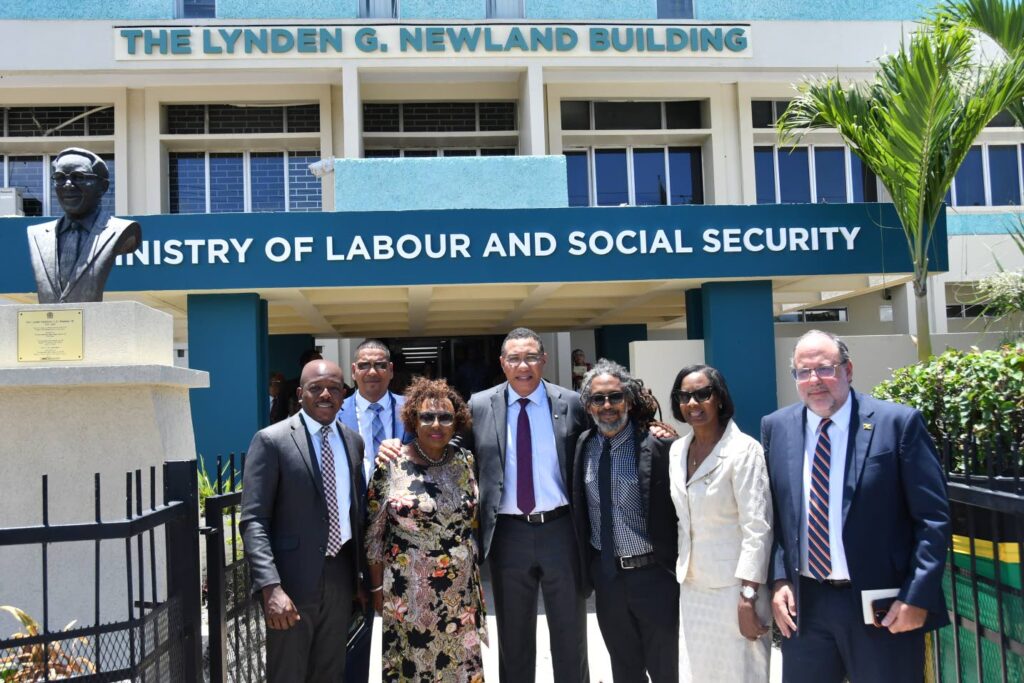
Six decades after he helped lay the groundwork for one of independent Jamaica’s most critical social protection institutions, the late Lynden Newland received a lasting honor on Tuesday, as the headquarters building of the National Insurance Scheme (NIS) he co-founded was officially renamed in his memory.
Hosted at the agency’s 14 National Heroes’ Circle campus in St Andrew, the naming and dedication ceremony was a joint initiative by Jamaica’s Ministry of Labour and Social Security and the Ministry of Culture, Gender, Entertainment, and Sport, organized to celebrate Newland’s transformative contributions to the country’s social safety net.
Speaking on behalf of the Newland family, Stephen Newland framed the honor as far more than personal recognition. He explained that it celebrates the enduring impact of ideas and public service that outlive their creator. Affectionately calling the pioneer “Uncle Doc”, Stephen Newland traced the origins of the NIS, emphasizing that the scheme was the product of years of collaborative effort rather than a sudden inspiration.
“When Uncle Doc first developed these concepts in 1962, it wasn’t a sudden ‘eureka’ moment that spawned the NIS. It was a cumulative, snowballing process shaped by many brilliant minds—his own, his team, his support staff, and even his family,” he shared. He added that the vision that guided the NIS’s creation should remain a source of inspiration for young Jamaicans working to advance national development for decades to come.
Today, the NIS headquarters serves as the administrative hub for Jamaica’s mandatory national social security system. It manages all core operations, from registering working Jamaicans and collecting statutory contributions to processing critical benefits including retirement pensions, maternity allowances, and compensation for work-related injuries. For the country’s workforce and their families, the scheme remains an irreplaceable pillar of financial security, stepping in to replace income when workers are sidelined by sickness, injury, or retirement.
Prime Minister Dr Andrew Holness delivered the event’s keynote address, affirming that renaming the building for Newland is a deeply fitting tribute. Holness noted that Newland was part of the foundational generation that built the core governing institutions of newly independent Jamaica.
“That generation did not inherit a fully functional, established state. They had to envision what Jamaica would become, turn that vision into legislation, build out the public service, secure funding, and protect the nation they built. They turned Jamaica from a country with the symbol of independence into a functioning, substantive nation. As a former minister of labour and national insurance, Lynden Newland helped lay one of the strongest pillars of our country’s social protection framework: the National Insurance Scheme,” Holness said.
The prime minister emphasized that Newland’s work on the NIS was far more than a routine policy adjustment; it was a long-term commitment to guaranteeing dignity and security for all Jamaican workers throughout their lives.
“The National Insurance Scheme gave concrete form to a simple, powerful idea: work deserves dignity, and that dignity must be protected at every stage of life,” Holness stated.
He pointed out that while many Jamaicans may not recognize Newland’s name, they benefit from his work every single day. “Jamaicans know his legacy through the pension that supports a grandmother, through the protection that catches a worker after an injury, through the quiet promise that after a lifetime of contributing to the country, the country will support them when they need it. Even the National Housing Trust traces its roots to his work. This is a real legacy—not fanfare, not fleeting popularity, but lasting good,” he said.
Holness closed by noting that Newland’s legacy transcends generations, and will continue to shape Jamaican life for years to come. “A true legacy is when a decision made by one generation continues to protect people in the next and all the generations that follow. Today, by putting his name on this building, we are saying that the architecture of our state must always remember the architects of our national protection,” he said.