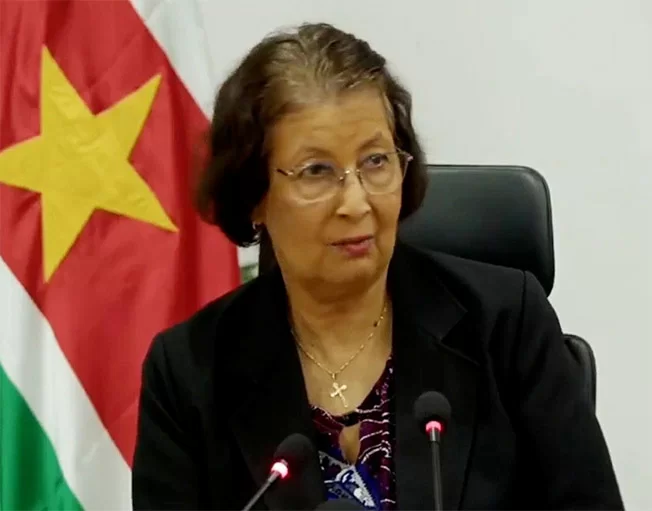
One year to the day after the May 25, 2025 national elections, President Jennifer Simons has opened up about her administration’s first 12 months in office, acknowledging that transformative change has yet to become tangible for most ordinary citizens while framing her government’s work as laying critical groundwork for long-term structural overhaul.
Speaking at a press conference on Monday, the president reflected on the post-election period and the lengthy process of forming her administration, noting that the past year has been marked by intense, complex negotiations required to build a broad cross-party coalition. “Our country is not a simple one. Though we are a resource-rich nation, that wealth also brings complexity, with a wide range of competing internal and external interests,” Simons emphasized during the address.
She outlined that the administration’s first year has focused overwhelmingly on three core priorities: stabilizing the national economy, streamlining inefficient bureaucratic processes, and laying the preparatory framework for sweeping structural reforms. Key early wins she highlighted include maintaining stable exchange rate levels, rolling out government-wide digitalization initiatives, and launching comprehensive performance reviews for all state-owned enterprises.
Simons stressed that fundamental institutional change cannot be rushed, drawing on her decades of prior experience working in the National Assembly, where she noted similar systemic overhauls took years to deliver tangible results. “You cannot turn a muddy pond into a glass of clean drinking water in a single step,” she illustrated. The president added that her administration is intentionally prioritizing long-term fixes to long-neglected systems and institutions, rather than pursuing high-profile symbolic projects that deliver no lasting benefit. “My primary goal is to build a bridge away from a system that has been broken over 60 years, so we can lay a solid foundation to rebuild it better,” she explained.
While Simons recognized that the general public is eager to see immediate improvements to daily life, she defended the government’s deliberate, step-by-step approach. Currently, she said, reform work is advancing across multiple key sectors, including public education, state-owned enterprise governance, public sector digitalization, and agricultural development.
Despite the president’s framing, public criticism has been growing across segments of civil society over the lack of immediate, concrete improvements to household finances. Most notably, many citizens continue to grapple with steep cost-of-living increases and minimal growth in purchasing power, even after one year of the new administration.
Simons pushed back against this critique by pointing to existing policy measures the government has implemented to buffer consumers from price hikes, including targeted interventions to cap fuel prices. She noted that the administration is working to strike a careful balance between expanding social support for vulnerable households and preserving hard-won macroeconomic stability. Moving forward, the president confirmed that the next phase of her term will focus on continuing to strengthen institutions and modernize the country’s governance framework, reaffirming that full delivery of the government’s reform agenda will take more time to reach all communities.