For generations, the coastal Surinamese district of Nickerie has been synonymous with rice cultivation, earning its reputation as the nation’s rice heartland. Today, however, a quiet shift is underway: local farmers are increasingly embracing crop diversification, adding citrus, coconut, banana, and other tropical fruit varieties to their agricultural operations, with some producers now managing plantations of thousands of citrus trees.
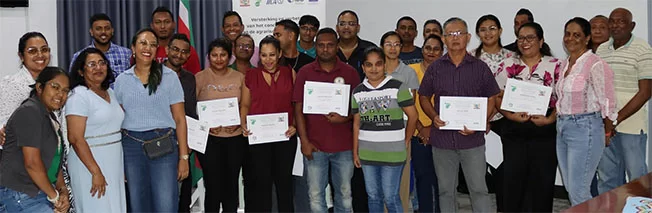
This growing transition toward diversified fruit production has been supported by targeted capacity-building initiatives led by Suriname’s Ministry of Agriculture, Livestock and Fisheries (LVV). Last week, a four-day Citrus Cultivation Technique training program wrapped up in Nickerie, designed to upskill local farmers and agricultural extension officers, with senior LVV officials on hand to mark the conclusion of the course. The program, which is part of the broader Strengthening of Citrus Production project funded by the Inter-American Development Bank (IDB), aims to boost national citrus output by equipping producers with science-based growing skills.
William Waidoe, Deputy Director of the LVV’s Western Region, highlighted that diversification is already well underway across Nickerie beyond just citrus: some producers have moved into aquaculture, while others have scaled up commercial banana plantations. “Our role is to support this transition by delivering the targeted training producers need to succeed,” Waidoe explained, noting that Nickerie boasts extensive areas of land perfectly suited to commercial citrus cultivation. The training modules cover practical, high-priority topics including disease prevention and management, pruning techniques, and sustainable soil management.
Rayen Toekoen, Acting Director of the LVV’s Directorate of Agricultural Research, Marketing and Processing, pointed to a notable trend that signals long-term momentum for the sector: strong interest from young producers. Even as Suriname attracts growing international attention for its emerging oil and gas sector, Toekoen noted that more young people are recognizing agriculture’s enduring role as a core economic pillar and a cornerstone of national food security. “Everyone is looking to oil and gas, but we cannot neglect our own domestic food production and food sovereignty,” Toekoen said. “That’s why the ministry is working to encourage young people to build careers in agriculture.”
Participants across age groups shared that the four-day course delivered actionable, practical knowledge that addressed longstanding challenges they faced on their farms. Teroen Lakhai, a young farmer who has worked in agriculture alongside his father from a young age, said the training finally solved a mystery that had plagued his citrus groves for years. “We had been fighting a persistent disease killing our trees for a long time, but we never knew it was HLB (Huanglongbing),” he explained, referencing the devastating bacterial infection that impacts citrus crops globally. “Now we understand what we’re dealing with, and how to manage it properly.”
Vikash Jurawan, who manages a large diversified plantation growing coconut, passion fruit, mangoes, oranges, grapefruit and soursop, called the program highly instructive, emphasizing that successful agriculture requires patience and long-term investment. “When you plant today, you don’t harvest and earn revenue in two months,” he noted. “It takes time, but the payoff is worth the wait.” For Davy Permaul, a new citrus grower who followed his father — a veteran rice and horticulture producer — into agriculture, the course provided foundational knowledge to start his operation, particularly in identifying and managing common pests and diseases.
Soesila Udit-Ramautar, head of the LVV’s Fruit Tree Research department and team leader for the IDB-funded citrus project, outlined the program’s national rollout timeline. Training sessions launched in December in the districts of Groningen and Saramacca, followed by courses in Wanica, Para, and most recently Nickerie. Additional sessions will be rolled out across other Surinamese districts in the coming months to expand access to citrus growing training nationwide.