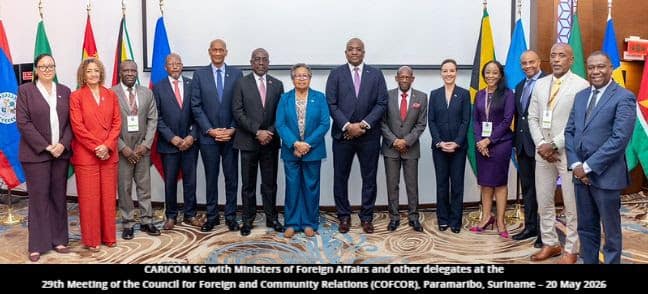
As the 15-nation Caribbean bloc CARICOM navigates a turbulent landscape of evolving global and hemispheric shifts, its top leader is sounding the call for deeper coordination among member states to project a unified, influential voice on the international stage.
On Wednesday, May 20, 2026, CARICOM Secretary-General Dr. Carla Barnett delivered opening remarks to foreign affairs ministers gathered in Paramaribo, Suriname, for the 29th Meeting of the Council for Foreign and Community Relations (COFCOR), emphasizing that collective action is not a choice for the bloc’s small island and coastal nations—it is a non-negotiable necessity.
Barnett framed the current global moment as one defined by rapid systemic shifts that reshape regional economies, cross-border trade partnerships and core foreign policy priorities for every CARICOM member. She reminded attending delegates that policy decisions emerging from COFCOR and other CARICOM governing bodies carry direct, tangible impacts on the economic prosperity and social well-being of the bloc’s 16 million citizens, pushing for outcomes that will reinforce the entire community’s long-term resilience amid uncertainty.
Against this backdrop of shifting global dynamics, Barnett outlined the bloc’s ongoing diplomatic strategy: strengthening long-standing partnerships with traditional allies while expanding diplomatic outreach to new global partners. During the 29th COFCOR meeting, CARICOM delegates are scheduled to hold targeted discussions with representatives from Japan, Singapore and the United Arab Emirates, focusing on areas of mutual strategic and economic interest.
Looking forward to the remainder of 2026, the Secretary-General stressed the critical need for coordinated, bloc-wide preparation for a packed slate of high-stakes global diplomatic gatherings that will shape outcomes on CARICOM’s top priority issues. These key issues include advancing reparatory justice for colonial-era harms, stabilizing the ongoing crisis in Haiti, addressing the accelerating impacts of climate change, securing equitable access to climate finance for vulnerable small states, and upholding global peace and security. The upcoming major events include the Commonwealth Heads of Government Meeting set to be hosted in Antigua and Barbuda, the annual United Nations General Assembly, the Organization of American States General Assembly, and the UN Climate Change Conference (COP31).
“One of our Caribbean Community’s greatest strengths is our ability to project a united voice,” Barnett told attendees, noting that this collective unity is the only tool that allows small developing states to meaningfully shape global decision-making processes that directly impact their futures. While she acknowledged the inherent challenges of balancing individual national priorities with shared regional goals, Barnett reaffirmed that cross-member coordination remains an essential foundation for CARICOM’s success. “None of our small nations can effectively confront these challenges in isolation. Working together is therefore not an option, it is an imperative,” she added.
Founded in 1973 via the Treaty of Chaguaramas—revised in 2001 to establish a regional single market and economy—CARICOM counts 15 full member states and six associate members, with a total population of roughly 16 million people, 60 percent of whom are under the age of 30. The bloc organizes its work around four core pillars: economic integration, coordinated foreign policy, human and social development, and cross-border security cooperation. Widely recognized as one of the most successful regional integration projects in the developing world, CARICOM aims to build an inclusive, resilient, and competitive global bloc that guarantees human rights, social justice, and equal opportunity for all citizens to thrive and share in shared prosperity. The CARICOM Secretariat, the organization’s central administrative body, is headquartered in Georgetown, Guyana.