On May 20, 2026, during a high-level official visit to the Commonwealth of Dominica, India’s Minister of State for External Affairs Pabitra Margherita toured ongoing development activities in the Kalinago Territory — the ancestral homeland of Dominica’s Indigenous Kalinago people — spotlighting a landmark collaborative resilience project backed by the United Nations Development Programme (UNDP). The visit underscored the depth of partnership between the Indian government, UNDP, the Dominican government, and the Kalinago community to advance locally led climate adaptation and inclusive sustainable development.
The on-site review centered on progress of the Strengthening Community Resilience within the Kalinago Territory (SCR-K) Project, a development initiative financed through the India-UN Development Partnership Fund, a mechanism managed by the UN Office for South-South Cooperation. The project is jointly implemented by UNDP, the Dominican government, and the Kalinago Council, rolling out an integrated development strategy focused on boosting climate-resilient agricultural practices, strengthening regional food security, restoring degraded forest and watershed ecosystems, and expanding sustainable Indigenous-led tourism to create stable local livelihoods. Throughout implementation, the project has centered inclusive community participation, gender equity, and national ownership of development priorities.
Margherita’s delegation toured multiple project sites that demonstrate how cross-border South-South cooperation is translating global support into tangible local impact for Dominica’s Indigenous population. The first stop was the Forestry Propagation Centre in Pond Casse, where local teams grow native tree seedlings for large-scale reforestation work across the Kalinago Territory. This restoration effort is a core component of broader watershed protection work, and it actively engages Kalinago children and young people to build intergenerational environmental stewardship.
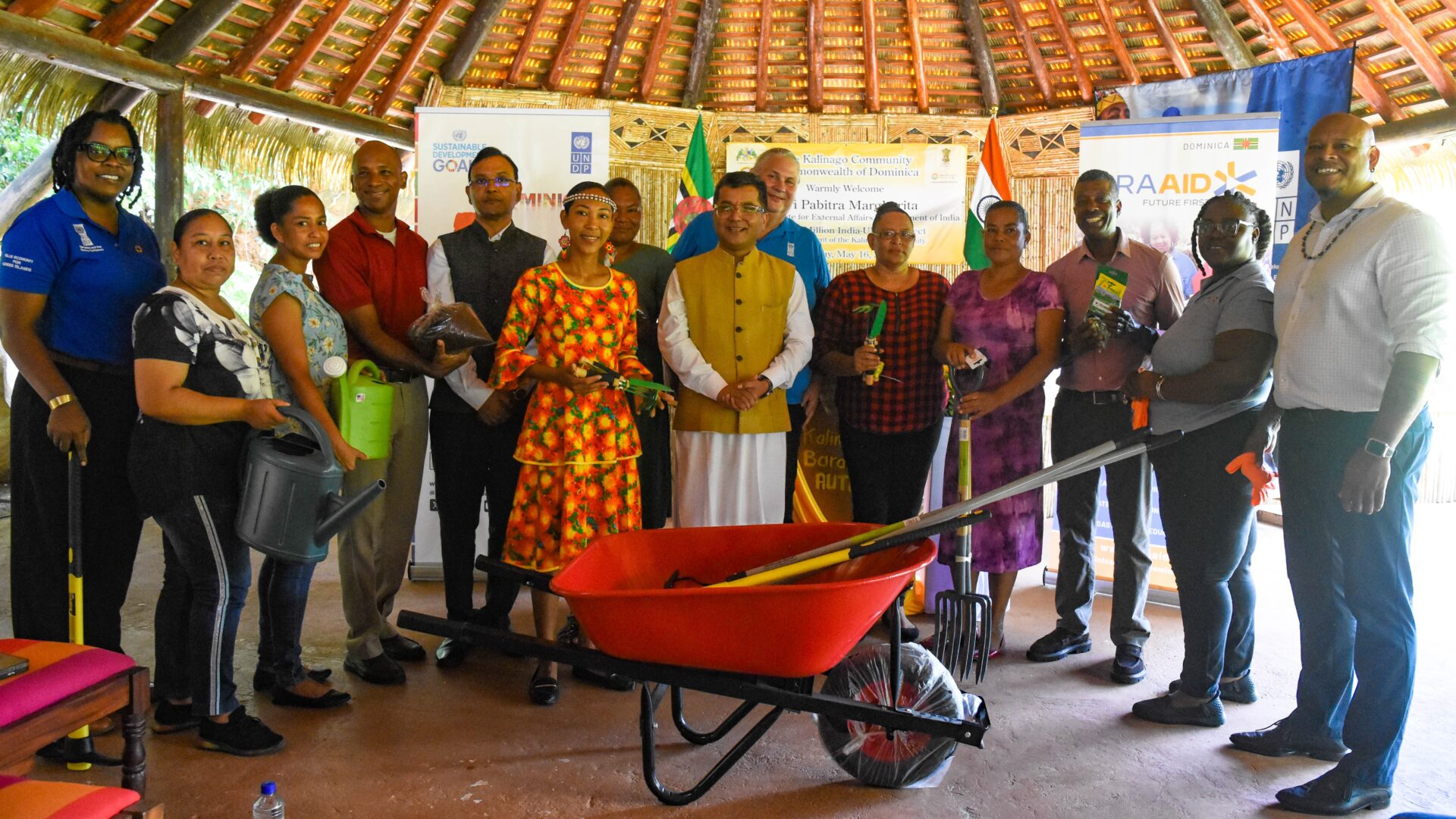
Next, the delegation traveled to Kalinago Barana Autê, a cultural heritage site operated by the Kalinago community, where they were greeted with traditional Kalinago cultural performances. Following the welcome, the delegation participated in a symbolic handover of backyard gardening kits to low-income and vulnerable Kalinago households. The kits are designed to expand local food production,推广 climate-smart farming techniques, and help households better absorb the economic and food security shocks brought by increasingly frequent extreme weather events, a top priority for climate-vulnerable small island nations like Dominica.
The visit also included a public tree-planting ceremony to mark ongoing restoration work, a guided tour of the Kalinago Barana Autê cultural grounds, and a live demonstration of traditional Kalinago cassava production. These activities emphasized the project’s commitment to centering Indigenous cultural heritage and traditional ecological knowledge alongside modern sustainable development goals.
The engagement brought together stakeholders from across the partnership, including senior representatives from UNDP, the Government of India, the Dominican Ministry of Foreign, International Business, Trade and Energy, the Dominican Ministry of Environment, Rural Modernisation and Kalinago Upliftment, the Kalinago Council, and local community members. The gathering reinforced the critical role of South-South cooperation in supporting community-designed solutions for climate resilience, sustainable livelihoods, and Indigenous development in Small Island Developing States (SIDS) that face disproportionate climate risk.
Speaking during the visit, Minister Margherita emphasized that India takes great pride in seeing the India-UN Development Partnership Fund deliver community-centered development to the Kalinago Territory. “This collaboration embodies the core spirit of South-South cooperation, rooted in shared solidarity, mutual respect, and alignment with locally identified development priorities,” he noted.
Cozier Frederick, Dominican Minister of Environment, Rural Modernisation and Kalinago Upliftment, welcomed the visit as a formal recognition of the multi-stakeholder partnership driving resilience and sustainable livelihoods in the Kalinago Territory. “Our ongoing collaboration with UNDP and the Government of India continues to advance our national development priorities and lift up local Kalinago communities,” Frederick stated.
Anette Sanford, Chief of the Kalinago Territory, thanked partners for their shared commitment to empowering the Kalinago community. “This initiative, led by UNDP with generous support from the governments of India and Dominica, reflects a collective promise to empower our people, invest in sustainable livelihoods, and build systems that let our community thrive,” Sanford said. “Your partnership demonstrates the power of collective action and international solidarity to address local challenges, and we are grateful for the national government’s consistent support for strengthening Indigenous communities. Most importantly, this work centers our community members — their participation and stewardship will shape the long-term impact of this project.”
Justin Shone, Head of UNDP’s Project Office in Dominica, highlighted the cumulative impact of India’s investment in the region. “We are grateful for the continued trust and partnership from the Government of India, which has provided funding through the UN Office for South-South Cooperation, and for our close collaboration with the Government of Dominica,” Shone explained. “This is the second project India has supported in the Kalinago Territory, bringing total investment to $2 million, and it is already driving real, lasting change to boost the resilience of the Kalinago people.”
Through its long-standing development partnership with Dominica, UNDP remains committed to supporting Indigenous peoples and vulnerable communities across the country to withstand and recover from climate and economic shocks, while strengthening local institutions and initiatives that advance inclusive, long-term sustainable development.