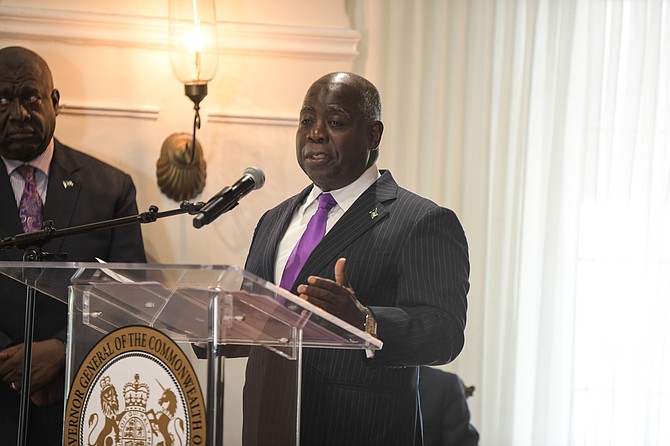
Fresh off a landslide general election victory that solidified his party’s hold on national power, Bahamas Prime Minister Philip “Brave” Davis is standing firm against growing criticism over the unprecedented size of his new Cabinet, arguing that a large, talented ministerial team is critical to delivering on the ambitious campaign promises his Progressive Liberal Party (PLP) made to voters.
The political clash erupted this week following the PLP’s resounding win in the May 12 general election, where the party secured 33 of the 41 available parliamentary seats — a decisive mandate that gave Davis near-total control of the national legislature. When the new administration unveiled its ministerial line-up, it immediately drew public and opposition scrutiny: at 29 members total, the Cabinet includes 21 full Cabinet ministers, seven junior ministers of state, and the prime minister, making it the largest ruling council in Bahamian history.
This new Cabinet represents a notable expansion from the 22-member team Davis assembled when he first took office in 2021, and dwarfs the 16-member initial Cabinet of the previous Free National Movement (FNM) administration, which took power in 2017 with just 13 full ministers and three ministers of state. When measured against population, the scale becomes even more striking: with the Bahamas’ total population sitting just above 400,000, the country now has roughly one national minister for every 14,000 residents. For context, far more populous Caribbean nations including Jamaica and Trinidad and Tobago maintain ministerial teams of roughly the same size, despite having millions more citizens.
Speaking during a ceremonial swearing-in event for nine newly appointed senators, Davis pushed back against critics, emphasizing that the government has a full slate of urgent near-term priorities and long-term transformative national goals that require the most capable leaders in key roles.
“We need the best hands on deck,” Davis stated. “At the start of our last term, some already questioned our move to expand the size of the administration. But it was precisely that approach that allowed us to deliver the progress that earned us a renewed vote of confidence from the Bahamian people. Now, the task ahead is even larger, so we must bring every available talent to bear to deliver on our commitments.” This echoes Davis’s reasoning after the 2021 election, when he argued the scale of the country’s challenges demanded an “all hands on deck” governing strategy.
But Opposition Leader Michael Pintard, who was recently sworn in to lead the FNM following the party’s election defeat, argues that the oversized Cabinet poses a direct threat to parliamentary accountability. The core of his criticism centers on the fact that the vast majority of the PLP’s elected parliamentary representatives now hold paid Cabinet positions, leaving only a tiny handful of ruling-party backbenchers — the elected MPs who do not hold government posts and are traditionally responsible for providing internal scrutiny of the administration from within the ruling party’s ranks.
“One of the core reasons we must remain vigilant in holding this government to account is that the government has effectively silenced its own backbench,” Pintard said. “This arrangement leaves almost no room for independent scrutiny from ruling party elected members. It is inappropriate for the majority of an administration’s elected representatives to hold Cabinet posts, because what healthy governance requires is robust, open debate and space for disagreement. Backbenchers are supposed to hold the Cabinet accountable, but we already knew this administration has no interest in dissent — we have seen that repeatedly, so this move does not surprise us.”
Beyond accountability concerns, Pintard also raised questions about the additional public financial burden that 29 senior government appointments will place on national coffers, urging the government to disclose the full cost of the expanded Cabinet. The opposition leader added that his party would carry out its constitutional oversight responsibilities by supporting government policies that benefit the Bahamian people and opposing measures that do not serve the public interest.
Turning to the FNM’s own post-election reflection, Pintard acknowledged that both the ruling PLP and the opposition FNM failed to energize voters in the recent contest, contributing to low turnout and widespread public disillusionment with the political system. He added that rebuilding public trust in political institutions is a critical task for all national leaders, and the FNM is conducting a full, transparent review of every factor that led to its recent election defeat.
“We are still assessing all contributing factors, from personnel choices at every level starting from the top leadership,” Pintard said. “We are committed to taking a sober, honest look at what worked and what did not, and making the necessary adjustments — nothing is off the table. I am deeply honored that the FNM executive council and our newly elected members have supported my return as leader, and I will repay that confidence with diligent work to rebuild our party and serve the Bahamian people.”