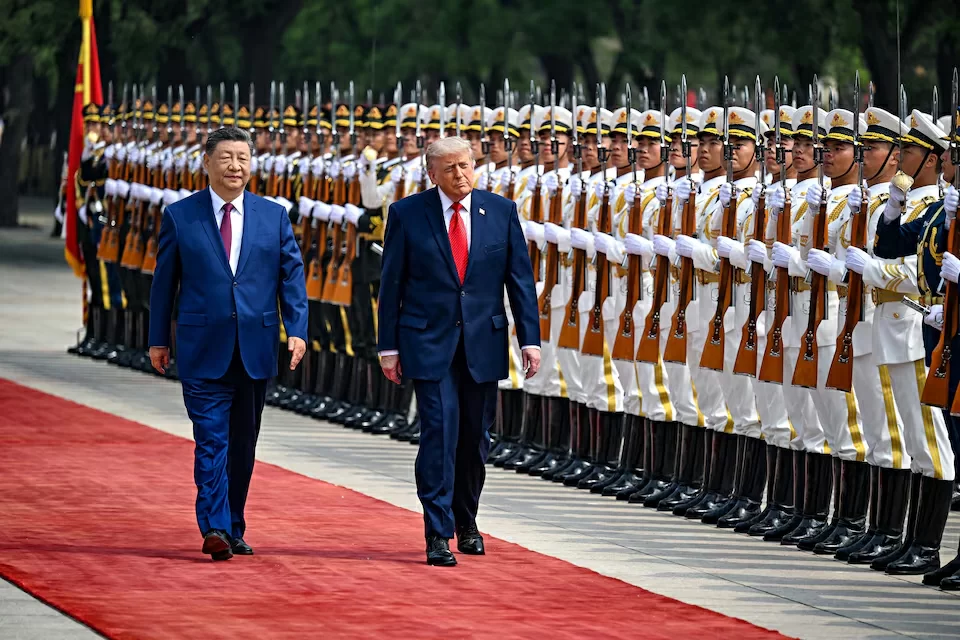
On May 14, 2026, U.S. President Donald Trump arrived in Beijing for a historic two-day summit with Chinese President Xi Jinping, marking the first visit by an American sitting president to China in nearly a decade. The long-awaited high-level meeting brought the world’s two largest powers together to confront a sprawling agenda of divisive geopolitical and economic issues, at a moment of growing global uncertainty fueled by regional conflict and shifting trade alliances.
In closed-door strategic talks, President Xi delivered a firm warning on one of the most sensitive flashpoints in bilateral ties: the Taiwan question. Xi stressed that any misstep in handling the issue would push U.S.-China relations into “extremely dangerous territory.” China has long maintained that Taiwan is an inalienable part of its sovereign territory, while the United States retains a long-standing legal commitment to provide defensive support to Taipei. Senior U.S. administration officials reaffirmed during the summit that Washington’s long-held policy of strategic ambiguity on cross-strait relations remains unchanged.
Beyond cross-strait tensions, the two leaders turned their attention to critical global energy security. The Strait of Hormuz, the world’s most vital energy chokepoint that carries roughly one-fifth of global oil and liquefied natural gas supplies, has seen major disruptions amid ongoing escalations in the conflict with Iran. The two leaders agreed to pursue coordinated efforts to keep the strategic waterway open to international navigation. The summit also revealed China’s growing interest in increasing purchases of U.S. crude oil as part of broader efforts to diversify its energy imports and reduce its overreliance on Middle Eastern energy supplies.
On the economic front, Trump announced that China had finalized an agreement to purchase 200 commercial aircraft from U.S. aerospace giant Boeing. The deal marks the first major U.S. commercial aircraft contract secured by Boeing in the Chinese market in nearly 10 years, a symbolic breakthrough after years of frozen trade engagement. While the total value and volume of the agreement fell short of initial market expectations, it signals a shared commitment to normalizing bilateral trade ties following the fragile partial trade deal reached between the two powers last October.
During the discussions, Trump also raised the case of Jimmy Lai, the imprisoned Hong Kong-based media tycoon and prominent critic of Beijing, who is currently serving a lengthy prison sentence. The U.S. delegation stated that it hopes for a positive outcome on the issue, though Chinese officials have repeatedly emphasized that matters related to Hong Kong are purely internal affairs of China, falling outside the scope of foreign interference.
The summit comes as Trump seeks to shore up his domestic political standing ahead of upcoming political cycles, but his agenda in Beijing was constrained by ongoing challenges: stalled progress on broader trade negotiations and ongoing political and military fallout from the U.S.-linked conflict in Iran that has left his administration vulnerable to domestic criticism.
By the end of the two-day meeting, the two leaders closed their summit with a working lunch and informal off-the-record talks, with both issuing a joint statement expressing a shared desire to strengthen overall bilateral cooperation. That said, fundamental disagreements on core issues remain unresolved, and those differences are expected to shape the trajectory of U.S.-China relations in the coming months. As the leaders wrapped up their talks, the global community continues to closely watch how the world’s most consequential bilateral relationship will evolve amid a period of unprecedented global geopolitical upheaval.