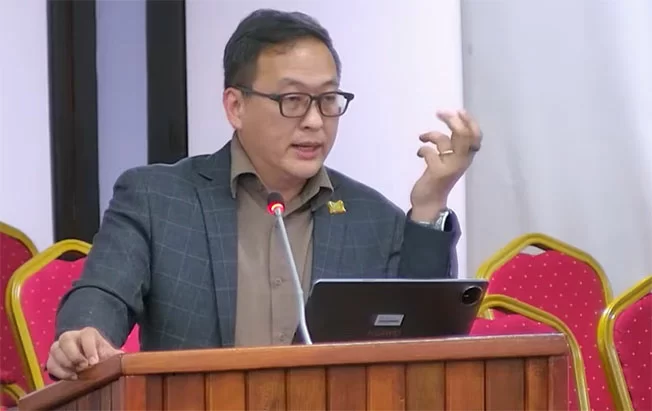
On Thursday, three top Surinamese government officials faced the National Assembly to outline the state of the country’s ongoing flood crisis and the steps the administration is taking to mitigate damage and prevent future disasters. Public Works and Spatial Planning Minister Stephen Tsang, Agriculture, Livestock and Fisheries Minister Mike Noersalim, and Government Coordinator André Misiekaba delivered detailed testimony before the legislative body, laying bare the depth of infrastructure decay that has compounded the impact of recent extreme rainfall.
Tsang opened his address by explaining that when his cabinet took office in late July 2025, it inherited a decades-long backlog of critical infrastructure maintenance that left both water-related and land-based infrastructure in what he described as a deplorable state. “We found trees growing inside drainage canals and sea outfalls. Drainage sumps were completely clogged with garbage, and we even recovered discarded mattresses, refrigerators and gas stoves from these waterways,” Tsang told parliament.
The minister added that the majority of the government’s heavy equipment tasked with maintaining drainage infrastructure was either broken or entirely non-functional when the new administration took office. None of the country’s three dedicated dredging pumps operated at full capacity, he confirmed. In the months since, multiple pieces of equipment have been repaired, and the government has launched a combined operational model that relies on both public assets and contracted private construction firms to address urgent needs.
Since September 2025, Tsang noted, the government has been building a long-term structural program focused on clearing outfalls, rehabilitating roadway networks, and upgrading national drainage systems across the country. He emphasized that the extreme rainfall that triggered the latest round of severe flooding was far outside normal weather patterns for the region. While 25 to 50 millimeters of rain is already classified as heavy precipitation for Suriname, measurements recorded on May 10 showed between 80 and 110 millimeters of rain falling across affected areas in just one event. “With that amount of water, major problems are unavoidable,” Tsang said. Even so, he added that preliminary interventions already completed have allowed floodwaters to recede far faster than they would have in previous years.
Currently, active mitigation work is underway in multiple high-priority communities including Wintiwai, Pontbuiten, Rahimal, Leiding 10A, and Domburg, according to Tsang. In the coming months, the government will launch new bidding processes for additional contracts to clear canals and upgrade drainage networks across multiple districts. Rehabilitation work on critical sluices and pump stations is also ongoing in Paramaribo-Noord, Santo Boma, and other flood-prone regions.
Looking ahead, the government is partnering with the Inter-American Development Bank to develop and deploy early warning systems for extreme weather events, a proactive measure designed to give communities more time to prepare for future flooding. An interdepartmental crisis working group has also been established, bringing together representatives from Public Works, Agriculture, Spatial Planning, and the National Disaster Management Coordination Center to align response efforts.
For his part, Agriculture Minister Noersalim confirmed that his ministry has also deployed all available heavy equipment to address acute flood issues in key agricultural and residential regions including Nickerie, Saramacca, Weg naar Zee, and Commewijne. He noted that the ministry faced an early challenge just mapping out what operational equipment was actually available, a process that revealed significant gaps in the government’s asset inventory. “It was a complicated puzzle to piece together. Police are still conducting investigations into the whereabouts of a number of missing pieces of heavy equipment,” Noersalim explained.
During clearing work on the Jahkrikreek in Saramacca, crews have encountered massive volumes of illegally dumped waste clogging the waterway, he added. To keep public spending under control, the ministry is prioritizing carrying out as much clearing and mitigation work as possible with in-house resources, only bringing in private contractors when work cannot be completed by public teams. A public tender for seven new flood mitigation projects is scheduled for next week, Noersalim confirmed.
Government Coordinator Misiekaba closed the parliamentary briefing by calling for understanding and support from both the public and parliament for the government’s recovery efforts. He stressed that even modern, well-maintained drainage systems struggle to cope with extreme rainfall events of the scale Suriname recently experienced. “Guyana was flooded, Trinidad was flooded, even Hilversum in the Netherlands was inundated by recent heavy rains,” Misiekaba noted, adding that it will take significant time to fully eliminate the decades of maintenance backlog that left the country so vulnerable to flooding.
Misiekaba also acknowledged that the government currently faces limited capacity to allocate new funding for flood mitigation work, as the 2026 national budget has not yet been finalized and approved by parliament. Even with these constraints, he guaranteed that the administration would not abandon communities affected by flooding. “Ministers are on the ground with communities every single day, working to identify ways to bring relief to those impacted,” he said.