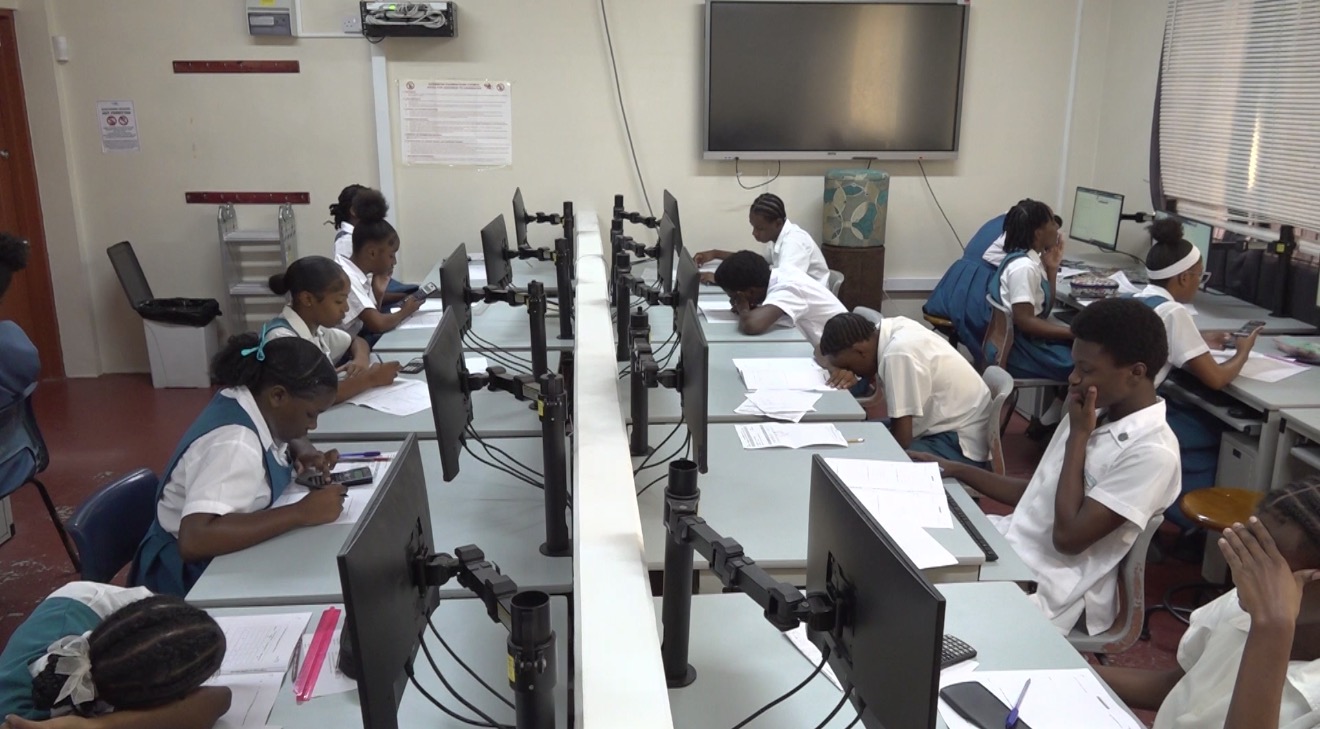
A landmark shift in secondary education assessment across the Caribbean is underway, as Saint Lucia hosted the inaugural sitting of the Caribbean Targeted Education Certificate (C-Tech) exams this week. The new modular assessment framework, which launched Tuesday, is designed to upend the traditional one-and-done testing model that has long defined the region’s Caribbean Secondary Education Certificate (CSEC) system.
Unlike the standard CSEC structure, which requires students to sit exams for all required subjects in a single sitting to earn full certification, C-Tech enables learners to complete their syllabus in incremental, self-paced stages. Students work toward their full credential one module at a time, gradually building up to a full CSEC pass after successfully completing three separate modules.
Patterson Abraham, Registrar of Examinations at the Caribbean Examinations Council (CXC), the body governing regional education assessments, explained that CXC selected mathematics as the subject for the very first C-Tech module. Mathematics has historically been one of the most challenging subjects for students across all Caribbean nations, with consistent low pass rates dragging down overall academic outcomes for thousands of learners annually.
Drawing on decades of regional performance data, Abraham noted that the staggered modular model gives students far greater opportunity to earn incremental micro-credentials along their journey, even before they complete the full certification requirement. By breaking the large, comprehensive mathematics syllabus into smaller, more focused sections, the framework reduces the academic burden placed on learners. “The number of areas that they have to cover is less than the CSEC programme,” Abraham explained. “Students can focus on a few topics at a time, and to be able to do as well as they can on just one module, and then to build onto the next module.” This segmented approach makes the subject far more manageable, lowering the barrier to success for struggling learners.
After completing site visits to multiple participating examination centers on the first day of testing, Abraham reported that the launch went far smoother than many observers expected. The first C-Tech exam used a modern hybrid format: paper one of the module was administered prior to Tuesday, and Tuesday’s sitting was for paper two, where students accessed test questions via digital devices and recorded their responses in traditional printed answer booklets. This blended digital-write-in structure marks a small but meaningful step toward modernizing assessment practices across the region.
Abraham confirmed that no major logistical issues or security incidents were reported across any testing sites, with all operations running according to plan. “From my visits and from my communication with the centres that are doing C-Tech, everything seemed to be under control,” he said. Regional education officials are now optimistic that the full 2024 C-Tech exam sitting will conclude successfully, paving the way for a broader rollout across other Caribbean nations in coming years.
Framing the new initiative as a transformative milestone for Caribbean secondary education, Abraham expressed confidence that the flexible modular framework will deliver tangible long-term benefits, boosting overall academic performance and opening up more education and career pathways for regional students.