As tensions escalate over the decades-long territorial dispute between Venezuela and Guyana over the resource-rich Essequibo Region, a senior U.S. diplomat has confirmed that Washington is holding closed-door diplomatic negotiations to de-escalate the crisis, after Venezuela’s leader rejected any binding ruling from the International Court of Justice (ICJ) on the conflict.
U.S. Under Secretary of State for Economic Affairs Jacob Helberg made the announcement Wednesday during a press briefing at the U.S. Embassy in Georgetown, Guyana, at the conclusion of a one-day official visit to the South American nation. Helberg emphasized that the U.S. is keeping close watch over ongoing proceedings at the ICJ, and agrees that regional security is a foundational requirement for economic growth and prosperity across the hemisphere.
“Ultimately a lot of those conversations right now will be private, and we believe that we can make progress through private conversations,” Helberg told reporters, declining to disclose which parties are participating in the backchannel discussions. The comment came in response to a question from Demerara Waves Online News, which asked whether the U.S. was prepared to step in as a mediator to preserve hemispheric stability and energy security, should Venezuela maintain its hardline stance against the ICJ’s authority.
The territorial dispute carries major energy stakes: ExxonMobil and multiple other U.S. oil firms hold offshore exploration concessions in the Essequibo Region, and have tied their long-term development plans to a binding ICJ ruling on the conflict, which is expected to be issued either by the end of 2026 or in the first quarter of 2027.
The standoff reached a new flashpoint earlier this week, following dramatic developments from both Caracas and Washington. On Monday, Venezuelan Interim President Delcy Rodriguez told the ICJ that her government would refuse to abide by any court decision that upholds the 1899 Arbitral Tribunal Award, the agreement Guyana recognizes as the final settlement of its shared border with Venezuela. Rodriguez reaffirmed Venezuela’s long-held position that the dispute can only be resolved through bilateral negotiations, based on Caracas’s interpretation of the 1966 Geneva Agreement signed between Venezuela and the United Kingdom, which was Guyana’s colonial ruler at the time. Notably, Venezuela omits reference to a key clause in the 1966 deal that permitted the U.N. Secretary General to refer the unresolved conflict to an adjudicatory body like the ICJ; the U.N. took that step, clearing the way for Guyana to file its formal case with the court.
During her ICJ appearance, Rodriguez repeated her longstanding accusations that Guyana has colluded with ExxonMobil, the U.S. government and U.S. Southern Command to carry out what she frames as an imperialist plot to seize the Essequibo Region from Venezuela.
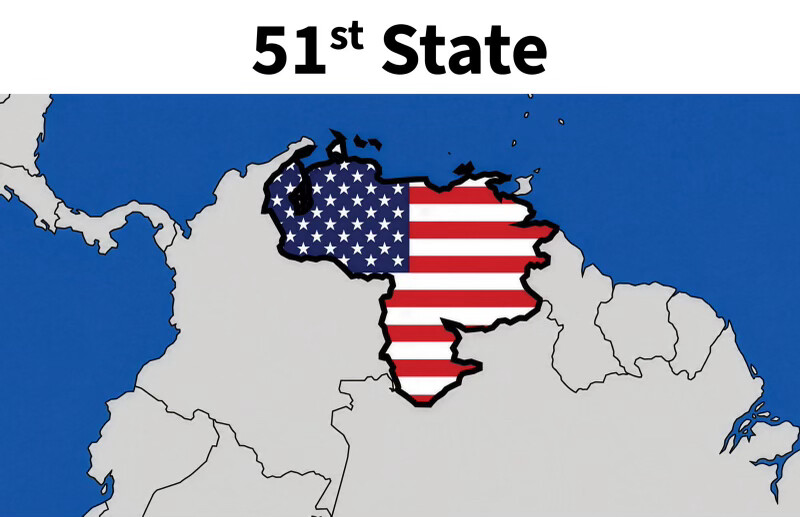
A day before Helberg’s visit to Guyana, U.S. President Donald Trump drew global attention to the dispute with a post on his Truth Social account, shared to X (formerly Twitter). The post included a map of Venezuela that omitted the entire Essequibo Region, alongside a fully recognized map of Guyana that includes the contested territory shaded within the U.S.-shaded map of Venezuela.
The decades-old dispute has flared in recent years following the discovery of massive oil reserves offshore Essequibo, turning a long-simmering territorial conflict into a high-stakes issue for global energy markets and regional security in South America.