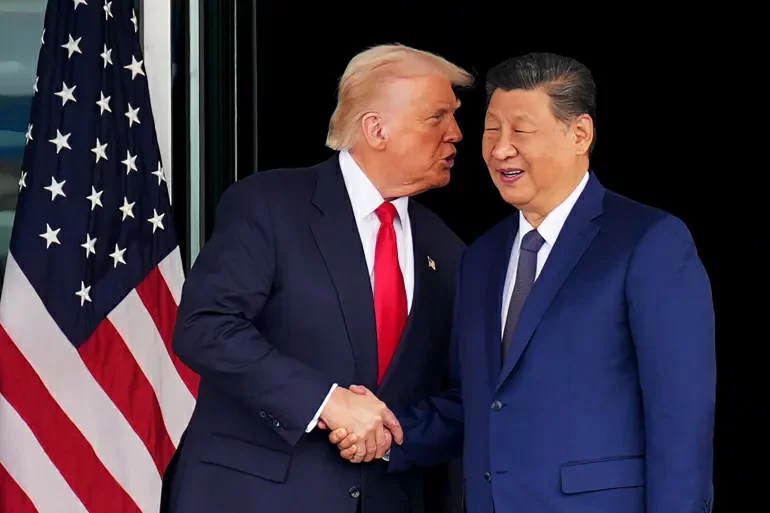
A high-stakes bilateral summit between the leaders of the United States and China in Beijing has reignited global debate over the decades-old idea of a “Group of Two” (G2), an informal power-sharing arrangement that would see the world’s two largest economies jointly steer global governance amid shifting geopolitical tides.
U.S. President Donald Trump arrived in Beijing on Wednesday for the two-day meeting with Chinese President Xi Jinping, marking their first in-person encounter in six months. The talks come after the two sides reached a temporary truce in their long-running trade dispute, though the summit was originally scheduled for March before being postponed amid escalating conflict involving the U.S., Israel and Iran.
The broader Middle East crisis has already put fresh strains on bilateral ties: Iran’s closure of the Strait of Hormuz and subsequent U.S. countermeasures have disrupted Chinese commercial shipping and crude oil imports, nearly half of which come from the Middle East. Analysts widely expect Trump to push for a coordinated international military operation to reopen the strategic waterway, a proposal Beijing has opposed until now. For his part, Xi is anticipated to push for progress on core Chinese priorities, including expanded trade access, clarity on rare earth mineral trade rules, and a shift in U.S. policy regarding Chinese claims over self-governing Taiwan.
The G2 concept has gained new traction as Trump has openly threatened to withdraw the U.S. from NATO over what he calls alliance members’ insufficient support for the U.S.-led campaign against Iran, pushing Washington further away from its traditional transatlantic and Asia-Pacific allies.
First proposed in 2005 by prominent American economist C. Fred Bergsten, the G2 framework centers on the idea that the world’s two largest economies should share collective responsibility for stabilizing the global economy and addressing cross-border challenges, rather than operating in a zero-sum competition for global dominance. The concept gained significant mainstream attention during the Obama administration, which launched the U.S.-China Strategic and Economic Dialogue in 2009 to foster constructive cooperation on shared global priorities ranging from climate change to the clean energy transition.
Still, the idea of a U.S.-China G2 faces widespread skepticism from both policymakers and analysts, who warn that such a bilateral arrangement would undermine multilateral global governance and allow the two superpowers to prioritize their own national interests over the needs of smaller and middle-sized states.
Many global powers have already made their opposition clear. European Union leaders fear a G2 would weaken Europe’s global standing, particularly in trade and technological supply chains, prompting the bloc to accelerate efforts to reduce its dependence on both the U.S. and China for critical inputs including energy and rare earth minerals. Major emerging economies within the BRICS grouping, including India and Brazil, also view a closer U.S.-China bloc as a direct threat to their own regional and global geopolitical ambitions.
Jing Gu, an analyst based in the United Kingdom, frames the Beijing summit less as a launch of a formal G2 and more as a strategic exploratory meeting. “Both sides are testing one another’s red lines and working to de-escalate existing tensions to avoid open conflict,” he notes.
Steve Tsang, a leading London-based China expert, predicts the summit will likely produce a limited bilateral trade deal but argues a full-fledged G2 arrangement remains deeply unlikely. “Both Trump and Xi prioritize positioning their own country as the world’s leading superpower, a status that cannot be shared equally between two competing nations,” Tsang explains.
The pair’s last meeting in Busan, South Korea in October 2025 was widely viewed as a positive step for bilateral relations: Trump himself publicly labeled the encounter a “G2 meeting” even though no formal agreement on the framework was reached, while Xi emphasized the potential for constructive partnership even as underlying great power tensions remained unaddressed.
Despite China’s rapid rise as a global technological and economic power, Washington has yet to formally recognize Beijing as an equal peer on the global stage, a structural barrier that makes deep, long-term cooperation difficult to sustain.