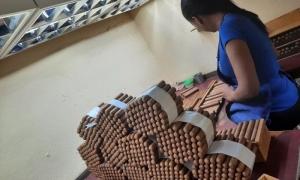
For a Cuban tobacco producer in the eastern province of Las Tunas, the shift to renewable energy is more than an environmental initiative — it is a lifeline for an industry with centuries of local heritage that has struggled with crippling power instability and economic headwinds in recent years.
The Las Tunas Tobacco Collection, Processing, and Rolling Company (known locally by its Spanish acronym ABTT) now produces nearly 60 kilowatts of electricity through newly installed photovoltaic panels across its manufacturing facilities, which supply premium cigars for both domestic consumption and global export markets. While integrating renewable energy has been a core part of the company’s strategic roadmap for several years, the initiative was derailed for a period by persistent shortages of foreign currency, which blocked the purchase of critical equipment.
Before the solar rollout, chronic unreliable grid power forced frequent work stoppages across ABTT’s production workshops. Those disruptions hit output hard: at the time the transition plan was launched, the firm produced just over 400,000 export-quality cigars and nearly 1.5 million units for domestic sale, with annual revenue losses from outages topping 26 million pesos.
To address the crisis, parent group Tabacuba Business Group launched a full-scale energy transition across all core operations, starting with the Vidal Navas and Maniabón factories in Puerto Padre, which prioritize production for international export. Additional photovoltaic systems were added to select workshops at the Enrique Casals facility in Las Tunas municipality, another site focused on overseas sales.
Building on the early success of these first installations, the Lázaro Peña plant in Jobabo — which supplies the domestic market — is set to bring two 6-kilowatt solar panel modules online in the coming period, a change designed to reshape the facility’s energy profile and protect its consistent production output. According to Carlos Betancourt Almaguer, Development Director at ABTT, additional photovoltaic infrastructure will be rolled out incrementally across remaining workshops in the province, while contracting for new systems is already underway for other key sites, including a central tobacco sorting center and the company’s main distribution warehouse.
Beyond stabilizing production levels, Betancourt Almaguer noted that the shift has already improved workplace conditions for employees. Previously, unscheduled outages forced early shutdowns, cutting into workers’ daily wages. Now, staff arrive at the facility confident that production will proceed as planned, eliminating unexpected lost income.
The solar transition is not limited to manufacturing: the company has partnered with the Agricultural Projects Company and the Ministry of Agriculture to install solar-powered irrigation systems in 18 new seedling houses across nine independent tobacco producers’ farms. This on-farm renewable infrastructure will ensure planting can be completed on the optimal schedule, boost crop yields, and add greater reliability to the annual tobacco growing campaign.
For Las Tunas, a region with tobacco production roots stretching back to the 18th century, this widespread energy shift could mark the first step toward a broader industry recovery. After a revival of tobacco cultivation in 1993, the region saw rapid growth that cemented its status as one of Cuba’s top tobacco producing areas, hitting a peak in 2017 with a harvest of 1,276 tons of raw tobacco. In recent years, however, production has dropped sharply, with current annual output barely exceeding 100 tons. Industry leaders hope that resolving power instability through renewable energy will reverse that trend and restore the region’s historic standing in Cuban tobacco.