Escalating tensions over unaddressed land rights violations in Belize’s Indian Creek have sparked coordinated action from Indigenous Maya leaders across the Toledo District, who warn the current crisis is just the first of many flashpoints if the national government fails to intervene to protect communal land claims.
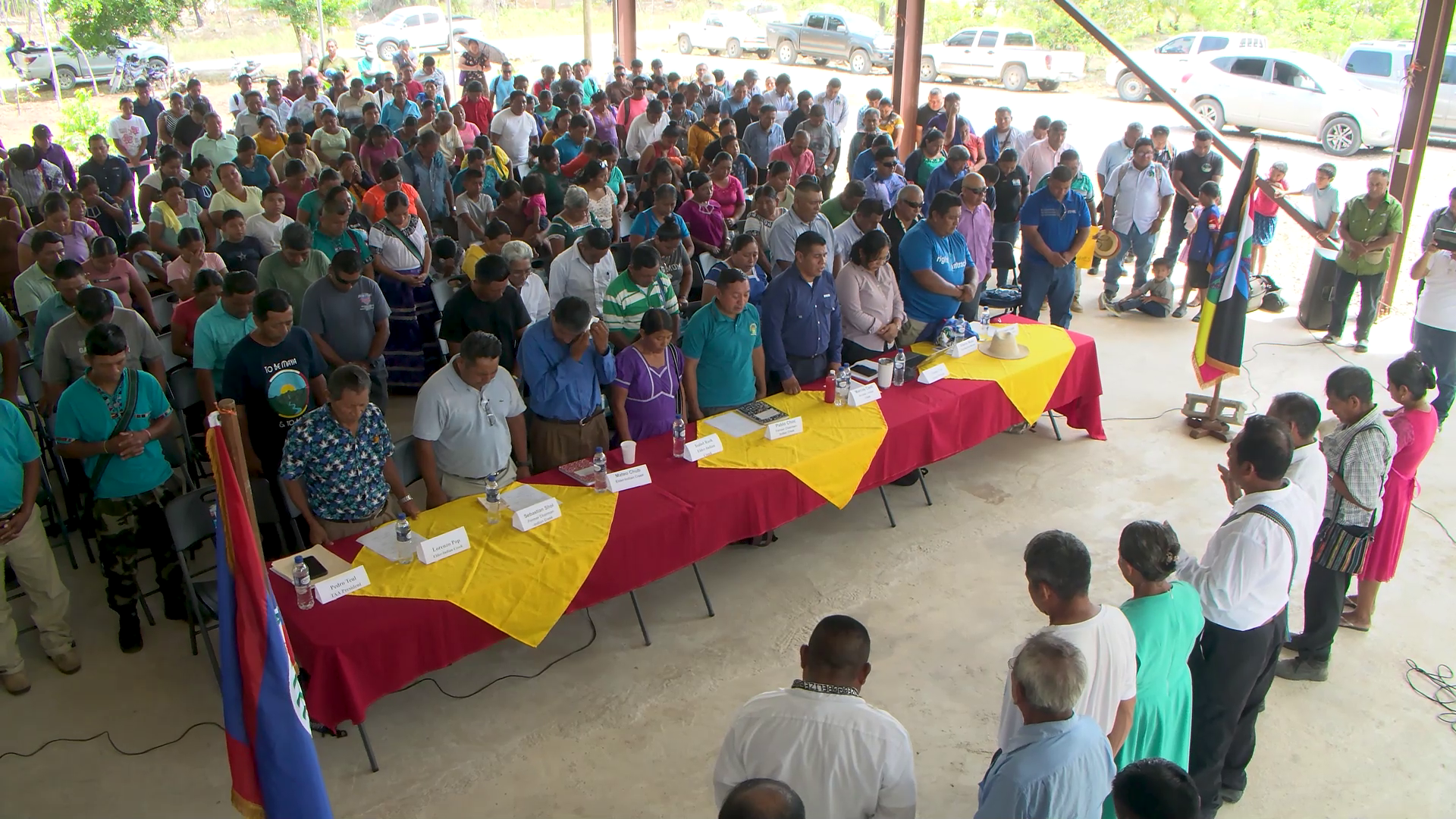
On Friday, dozens of leaders from affected communities traveled to Laguna Village to stand in collective solidarity, framing the Indian Creek unrest not as an isolated local dispute, but as a direct consequence of decades of government inaction, discriminatory policy, and systemic injustice targeting Maya territorial sovereignty. The unified group is preparing to bring their demands directly to Prime Minister John Briceño, pushing for urgent action on long-stalled land protections.
Edwin Caal, chairman of Golden Stream Village, one of the communities bracing for potential conflict, outlined three core grievances driving the growing unrest. First, the government has repeatedly delayed formal demarcation of traditional Maya communal lands, leaving boundaries ambiguous and open to encroachment. Second, officials have failed to pass legislation that would legally enshrine protected rights to these territories, instead advancing proposals that would restrict Indigenous land access – including a controversial plan that would cap individual Maya land holdings at just five acres per person, a limit the community has outright rejected.
Caal also leveled accusations of biased enforcement against government authorities, claiming officials consistently side with private third-party developers and outside interests over Indigenous residents when disputes arise. “When the third party do something like bulldozing and we report it, they don’t come ready to help us. But the minute we begin to protect our land from encroachment, they are ready to stop us, sometimes use police to stop us,” Caal said.
Similar claims of forced displacement and government complicity come from San Marcos Village, where chairman Alberto Muku explained that community members have lived and farmed on their traditional lands since the early 1990s, only to face systematic encroachment in recent years. An outside individual identified as Papi Pena has cleared large swathes of occupied community land with bulldozers, pressuring some residents to abandon their properties. While some residents were offered small financial payouts to leave, others received no compensation at all for their displacement, Muku said.
Muku also went public with accusations of political manipulation, revealing that he was personally handpicked by a ruling party political influencer to take over as village chairman, with the expectation that he would fragment community organizing around land rights. Rejecting that pressure, he joined the collective action in Laguna to uphold the demands of his constituents.
“Our population is growing, and our children depend on these lands for their future,” Muku said, adding that the current government’s actions will have lasting electoral and historical consequences for the People’s United Party administration.
In a direct address to Prime Minister Briceño, Muku emphasized that Maya communities are voting members of Belizean society, many of whom have supported the current ruling party. “History will remember your actions toward us today, and we will ensure that future generations remember them as well when we go to the polls [in the next general election],” he warned.
As tensions continue to simmer across southern Belize, Maya leaders are clear: without immediate, meaningful policy reform, formal land demarcation, and enforceable protections for communal Indigenous territories, the Indian Creek conflict will not be the last crisis. Community leaders say they will continue to push for systemic change to prevent further unrest across the district.