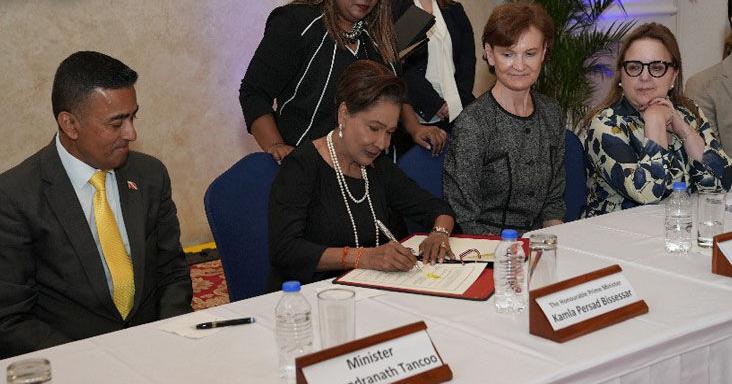
In a landmark move set to reshape development cooperation and investment prospects for the twin-island nation, the Government of Trinidad and Tobago has formalized an agreement with the World Bank Group to open a permanent, fully operational office in the capital city of Port of Spain. The deal, inked at St Ann’s Diplomatic Centre by Prime Minister Kamla Persad-Bissessar alongside senior World Bank Group leadership, brings all four core arms of the global institution—the International Bank for Reconstruction and Development (IBRD), International Development Association (IDA), International Finance Corporation (IFC), and Multilateral Investment Guarantee Agency (MIGA)—under one local roof.
The agreement establishes a clear legal and operational framework for the World Bank Group’s in-country presence, outlining a full suite of internationally recognized privileges and immunities that align with standard diplomatic practice for multilateral institutions. These protections include the inviolability of the organization’s office premises and archival records, limited immunity from legal proceedings for official acts, safeguards for the institution’s assets against seizure, search, or expropriation, and full autonomy over internal administrative and employment policies, which will remain governed by the World Bank Group’s own internal regulations. Additional terms grant the World Bank Group exemptions from all applicable taxes, customs duties, and levies on its operations, assets, and official transactions, while guaranteeing unrestricted access to global financial markets—the ability to hold and transfer funds in any currency without limitation—and the free import and export of equipment required for office operations, alongside access to secure, modern communication systems.
For Trinidad and Tobago’s government, the new permanent office represents far more than a diplomatic milestone: it is a strategic shift from intermittent, remote engagement with the World Bank to continuous, on-the-ground collaboration that will accelerate project delivery and strengthen national development efforts. Persad-Bissessar emphasized that the local presence will place the World Bank’s deep technical expertise and extensive financing capacity directly within Trinidad and Tobago’s borders, directly supporting the government’s core policy goals of economic diversification, private sector growth, and expanded job creation. A central pillar of this new partnership is a growing focus on public-private partnerships (PPPs), which the government has identified as a key driver of progress across critical infrastructure and social sectors.
Under the partnership framework, PPP initiatives will advance priority national projects in transportation infrastructure, integrated water management, public education, and healthcare delivery. These collaborations are designed to boost operational efficiency, speed up project implementation timelines, and expand access to much-needed capital for large-scale developments. Beyond public infrastructure, the partnership will also open new doors for local small and medium enterprises and entrepreneurs, improving their access to affordable capital, specialized business advisory services, and global export markets. Critically, government officials note that the formalized partnership sends a clear, strong signal to international investors that Trinidad and Tobago offers a stable, transparent, and investor-friendly business environment.
A central component of the new agreement is the expanded role of the IFC, the World Bank Group’s private sector-focused arm, which will lead efforts to mobilize global investment and support project development across the country. To date, the IFC has already invested more than US$670 million in Trinidad and Tobago across key sectors including financial services, manufacturing, and business development, dating back to the country’s accession to the World Bank Group in the 1960s. The expanded local presence will now unlock even greater opportunities for local firms to access capital and participate in large-scale infrastructure and public service projects.
Planning Minister Dr Kennedy Swaratsingh first signaled the government’s intent to facilitate the new office in October of the previous year, framing the move as a critical step to unlock untapped financing opportunities for the Trinidad and Tobago private sector. In line with that vision, the government is currently working with the World Bank Group to develop a robust project investment pipeline, with projected financing for local business-focused projects ranging between US$1 billion and US$3 billion. Broader development financing initiatives across all sectors are projected to reach as much as US$5 billion over the next three to five years.
Beyond domestic benefits, the new permanent office also positions Trinidad and Tobago to serve as a regional hub for World Bank Group operations across the Caribbean, creating opportunities for the country to expand its regional influence and coordinate cross-border development initiatives. For both parties, the agreement marks a new era of continuous, close collaboration that is expected to deliver long-term economic and social benefits for the people of Trinidad and Tobago.