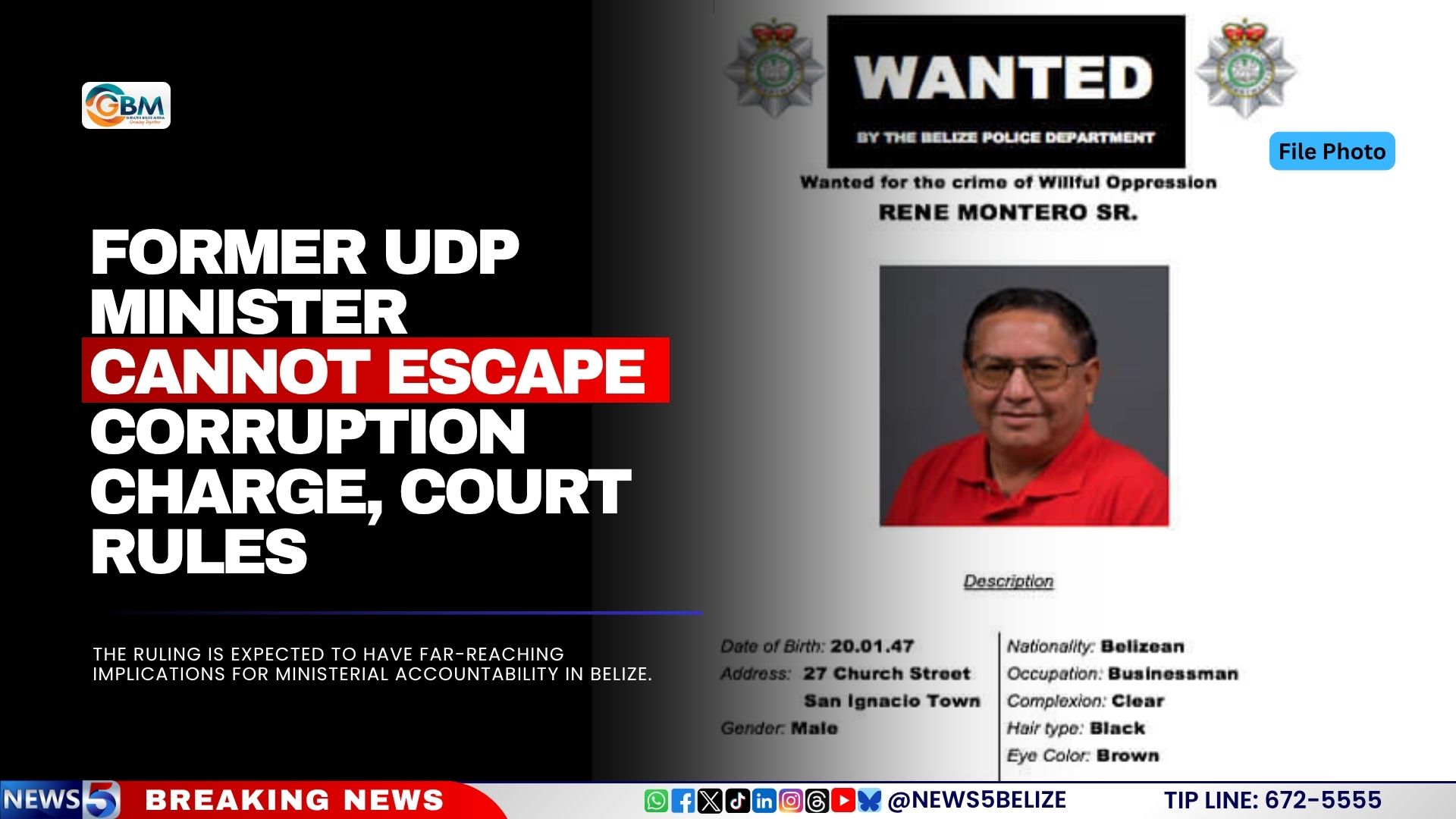
In a historic decision that reshapes the landscape of executive accountability in Belize, the Supreme Court has rejected a legal bid by former Cabinet Minister Rene Montero to dismiss corruption-related charges against him, confirming that sitting and former government ministers can be held criminally liable for abuses of power under the nation’s Criminal Code.
The case centers on allegations first brought in April 2024, when Montero—who previously served as the Works Minister under the UDP administration—and George Andrews, a former Assistant District Technical Supervisor at the Ministry of Works, were jointly indicted on charges of wilful oppression under Sections 284(1) and 309 of the Belize Criminal Code. Prosecutors allege that between April 2016 and November 2020, the pair deliberately misused their authority to direct and permit the improper diversion of public government resources, causing direct harm to the Belizean public.
Montero’s legal team launched a pre-trial challenge to have the entire indictment thrown out, grounding their argument in a technical constitutional interpretation. They pointed to Section 131(4) of the Belize Constitution, which explicitly excludes political Ministers from the formal definition of the “public service.” Counsel argued this exclusion should extend to the Criminal Code, placing elected ministers beyond the reach of Section 284(1) which only applies to “public officers.” They further contended that the Constitution intentionally draws a clear line between the political executive—held accountable primarily through electoral democracy—and the permanent public service, which is subject to administrative law oversight; erasing that distinction, they argued, was constitutionally invalid, especially in criminal law where status-based liability must be clearly defined.
The Director of Public Prosecutions (DPP) pushed back forcefully against this interpretation, noting that the Section 131(4) exclusion opens with the limiting phrase “In this Constitution,” meaning it was only intended to apply to the internal operational provisions of the constitutional document itself. The DPP argued Parliament never intended this narrow constitutional definition to override how criminal statutes define liability for public officials.
In her ruling delivered in late March 2026, Justice Natalie Creary-Dixon sided squarely with the prosecution. She emphasized that Section 299 of the Belize Criminal Code contains its own independent definition of “public officer, created explicitly for criminal law purposes and separate from any definitions laid out in the Constitution. Under the Criminal Code’s wording, a public officer is any person holding a civil office whose appointment and removal falls to the Governor-General or other specified official authority. Since all government ministers are formally appointed by the Governor-General under Section 40 of the Constitution, and hold non-military civil positions in the government, they clearly meet the plain language definition of public officer under the code.
The judge stressed that the Constitution’s exclusion of ministers from the definition of “public service” applies only to matters covered by the constitutional text itself, and does not grant ministers any blanket immunity from prosecution under ordinary criminal law. In a key passage of the judgment, Justice Creary-Dixon wrote: “The Constitution does not confer immunity upon Ministers from the application of criminal law. On one view, interpreting section 299 so as to include Ministers arguably advances the constitutional value of the rule of law by ensuring that holders of significant executive authority remain subject to legal standards governing abuse of public power.”
With Montero’s application to quash the indictment rejected, his criminal trial will move forward as scheduled. Legal analysts across Belize widely agree that this ruling will carry far-reaching implications for future cases of ministerial misconduct, establishing a clear precedent that no senior elected official is above the reach of criminal law when accused of abusing public office.