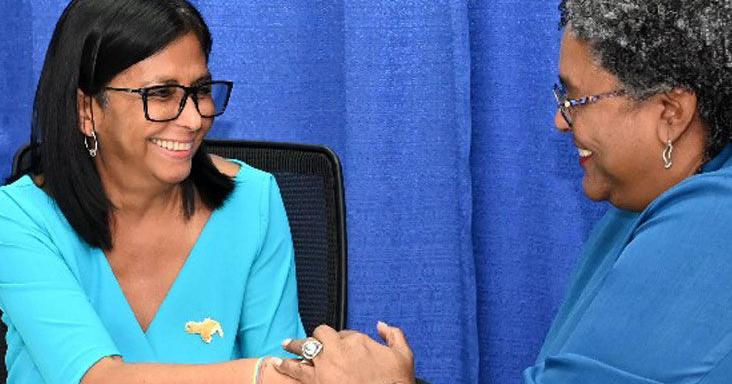
A seemingly small accessory has ignited a major diplomatic row across the Caribbean Community (Caricom), just days before a landmark international court hearing on one of the Western Hemisphere’s longest-running territorial disputes. The source of the tension is a deliberately worn brooch, shaped as a map of Venezuela that claims the resource-rich Essequibo region as Venezuelan territory, sported by Venezuela’s acting President Delcy Rodriguez during back-to-back official visits to two Caricom member states in late April 2026.
Rodriguez’s visit schedule saw her meet Grenada Prime Minister Dickon Mitchell on April 9, before traveling to Bridgetown on April 27 to hold talks with Barbados Prime Minister Mia Mottley. Her choice of accessory did not go unnoticed by Guyanese leadership, which has formally protested the act to Caricom chairman Dr. Terrance Drew in an official letter dated April 28, 2026.
For decades, the 159,000-square-kilometer Essequibo region — which makes up nearly two-thirds of Guyana’s current territory and holds vast untapped oil, mineral and forestry reserves — has been at the center of a sovereignty dispute between the two neighboring South American nations. The root of the conflict dates back to the 1899 Arbitral Award, which set the current border when Guyana was still a British colony. In 2018, Guyana launched formal proceedings at the International Court of Justice (ICJ) in The Hague to secure a binding ruling affirming the 1899 award’s legal validity and Guyana’s full sovereignty over the region. Oral hearings in the landmark case are scheduled to open on May 4, 2026.
Venezuela has consistently rejected the 1899 award as legally flawed, and has refused to recognize the ICJ’s jurisdiction over the dispute, instead pushing for negotiations under the 1966 Geneva Agreement framework. Despite Venezuela’s jurisdictional challenge, the ICJ ruled in 2023 that it holds authority to adjudicate the case, and issued binding provisional measures ordering both parties to maintain the status quo, avoid any actions that would escalate the dispute, and allow Guyana to continue administering the region. Upcoming oral hearings mark a major step toward a final binding resolution.
The current context of Venezuelan politics adds a new layer of urgency to the dispute: earlier in 2026, on January 3, a United States military operation removed long-time Venezuelan President Nicolás Maduro from power, taking him into custody to face criminal charges in New York. Rodriguez, a close ally of Maduro, was installed as acting president following Maduro’s ouster, and is preparing to contest upcoming national elections in Venezuela. Political analysts view her deliberate display of the disputed map as a move to galvanize nationalist support among Venezuelan voters ahead of the ballot.
In his formal letter to Caricom’s leadership, Guyanese President Dr. Irfaan Ali described Rodriguez’s brooch as a calculated and provocative escalation of Venezuela’s territorial claim, directly violating the ICJ’s provisional measures and the 2023 Argyle Declaration. That agreement, brokered by Caricom in St. Vincent and the Grenadines in December 2023, saw then-President Maduro and President Ali commit to avoid the use or threat of force, refrain from escalation, and respect the ongoing ICJ process while the case is pending.
Ali stressed that displaying a map claiming Essequibo as Venezuelan territory during official Caricom-hosted engagements risks being interpreted as regional acquiescence to Venezuela’s unlawful claim. “Venezuela cannot, while the case is before the Court, seek to normalise by symbols, maps, legislation, appointments or official display what it has failed to establish in law,” Ali wrote in the letter. He added that such provocative actions undermine Venezuela’s stated commitment to peaceful dispute resolution, international law, and good neighborly relations, noting that repeated symbolic and administrative moves to assert claim over Essequibo directly contradict the ICJ’s 2023 order requiring maintenance of the status quo.
The Guyanese president reaffirmed his country’s unwavering commitment to a peaceful, lawful resolution through the ICJ, noting that Guyana continues to place full confidence in the court’s process and upcoming ruling. He called on all nations, including Venezuela, to abide by United Nations Charter principles, refrain from provocative acts, and respect the ongoing judicial process. Ali also urged Caricom to uphold its long-standing stated support for Guyana’s sovereignty and territorial integrity in both official declarations and the conduct of official regional engagements, calling for continued vigilance to safeguard the bloc’s principled position on the dispute.
Reaction across Caricom has been mixed so far. Trinidad and Tobago Prime Minister Kamla Persad-Bissessar stated she remains unfazed by Rodriguez’s meetings with regional leaders, noting that Trinidad and Tobago maintains open diplomatic channels with Venezuela’s interim government. She also pointed out that Rodriguez, who was previously sanctioned by the United States, had only recently regained the ability to travel internationally for official engagements. In addition to her meetings with the Grenadian and Barbadian prime ministers, Rodriguez also held a previously unannounced meeting with former Trinidadian Prime Minister Stuart Young, who now serves as energy minister. Young publicly disclosed the meeting by posting a photo of himself and Rodriguez to social media.
Prior to Maduro’s ouster, Guyana and international partners had repeatedly accused Venezuela of violating both the Argyle Declaration and ICJ provisional measures through a series of escalatory moves, including formally declaring Essequibo a new Venezuelan state, moving to award oil exploration concessions in the disputed region, and conducting maritime incursions near Guyana’s existing offshore oil operations. International bodies including the Commonwealth have repeatedly stated that these actions run counter to the spirit of the Argyle agreement, and have called on Venezuela to adhere to the ICJ’s binding provisional orders.